
Current W907/W910 Sprinters use 6×130 and 6×205 bolt patterns, with factory alloy options in 16 inch and 17 inch sizes. Earlier W903 and W906 generations used 5×130 or 6×130 and 6×205 patterns, with a stronger emphasis on 15 inch and 16 inch wheels.
That generational change is why alloy wheels for a Mercedes Sprinter can't be selected by diameter alone. PCD, offset, centre bore and load rating all need checking against the exact chassis. A wheel that looks correct may still be unsuitable for the hub, body clearance or payload.
Table of Contents
- Mercedes Sprinter bolt patterns across three generations
- How do offset and centre bore affect Sprinter fitment
- What factory alloy wheel sizes were available for each Sprinter generation
- Why is load rating the critical Sprinter wheel specification
- Can one replacement Sprinter alloy wheel match an existing set
- Which finish suits Sprinter alloys, powder coated or diamond cut
- What Sprinter alloy wheel fitment mistakes should you avoid
- How can you source genuine OEM Sprinter alloy wheels
- Frequently asked questions
Mercedes Sprinter bolt patterns across three generations
The bolt pattern, also called PCD, is the first measurement to confirm. PCD describes the number of wheel bolts and the diameter of the circle passing through their centres. You can read a fuller explanation in this guide to alloy wheel PCD.
Independent UK fitment data identifies 5×130 on first generation W903 Sprinters. W906 models and current W907/W910 vehicles use the heavier commercial vehicle patterns 6×130 and 6×205, depending on the chassis and application. Diameter doesn't override PCD. A 16 inch wheel with the wrong bolt pattern won't fit safely.
| Generation | Years | Chassis code | Bolt pattern | Offset range ET |
|---|---|---|---|---|
| First generation | Not stated in verified UK data | W903 | 5×130 | ET75 to ET83 |
| Second generation | Not stated in verified UK data | W906 | 6×130 and 6×205 | ET55 to ET117 |
| Latest generation | Launched in 2018 | W907/W910 | 6×130 and 6×205 | ET47 to ET117 |
The figures in the table reflect UK Sprinter reference data from Oponeo's Sprinter wheel configurator, while the generation change and factory wheel progression are documented in UK Sprinter alloy wheel fitment data. The year field isn't expanded beyond the verified information, so use the VIN and chassis code rather than relying on registration year alone.
Practical rule: confirm the chassis code and PCD before looking at colour, spoke design or diameter.
The Alloy Hub Ltd. deals in genuine OEM wheels, so a proper enquiry should include the vehicle registration or VIN, the chassis code and photographs of the existing wheel markings. That prevents a visually similar wheel from being treated as interchangeable.
How do offset and centre bore affect Sprinter fitment
Offset is the distance in millimetres between a wheel's centre line and its mounting face. A positive offset places the mounting face towards the outer face of the wheel. The alloy wheel offset guide explains the measurement in more detail.
Sprinter offset envelopes vary substantially. First generation W903 reference data shows ET75 to ET83, W906 vehicles range from ET55 to ET117 and W907/W910 vehicles range from ET47 to ET117. Those ranges aren't interchangeable targets. They reflect differences in chassis, wheel width and hub geometry.
Centre bore is the diameter of the hole in the wheel that locates over the vehicle's hub. The wheel bolts clamp the wheel to the hub, but the centre bore still needs to locate correctly so the wheel sits concentrically. Never assume two 6×130 wheels share the same centre bore.
A sensible fitment check
- Record the PCD, diameter, width, offset and centre bore from the proposed wheel.
- Compare those details with the exact Sprinter chassis and factory fitment data.
- Check whether the wheel's load rating covers the required axle load.
- Confirm clearance and TPMS compatibility before fitting.
Offset changes alter the wheel's position relative to the hub, bodywork and suspension. On a commercial vehicle, the effect can become more significant under payload because clearance and load distribution matter together. Wheel alignment is a separate issue, but owners wanting broader technical background can read this wheel alignment guide from Woolpit Truck Repairs.
What factory alloy wheel sizes were available for each Sprinter generation
The historical progression is clear. W903 and W906 Sprinters typically used 15 inch steel wheels as standard, with optional 16 inch wheels. The W907/W910 generation, launched in 2018, widened factory availability to 15 inch, 16 inch and 17 inch steel or aluminium wheels. That makes current Sprinter alloy selection broader, but it doesn't remove the need to match the chassis and load specification.
| Generation | Alloy diameter | Rim width | Typical tyre size | Availability |
|---|---|---|---|---|
| W903 | 16 inch option | Not stated | Not stated | 15 inch steel generally standard, 16 inch optional |
| W906 | 16 inch option | Not stated | Not stated | 15 inch steel generally standard, 16 inch optional |
| W907/W910 | 16 inch | 6.5J | LT225/65R16 112/110R, LT225/75R16 118/116R or 225/75R16 121/120R | OE steel and aluminium options |
| W907/W910 | 17 inch | Not stated | Variant dependent | OE aluminium option on current models |
For the W907/W910, a typical OEM fitment is 6.5Jx16 ET62. The verified fitment tables also show approved 16 inch and 17 inch OE sizes with associated load capacities. A 2020 UK Mercedes-Benz Sprinter brochure lists 6.5Jx16 light alloy wheels alongside 225/65 R16 C and 225/75 R16 C tyre sizes.
These are factory-style reference points, not permission to fit any wheel with the same diameter. Width, ET, PCD, centre bore and load rating still need to match. Mercedes-Benz UK also notes that certain alloy options aren't available on 5-tonne models, which is a direct reminder that vehicle weight class limits wheel choice.
Why is load rating the critical Sprinter wheel specification
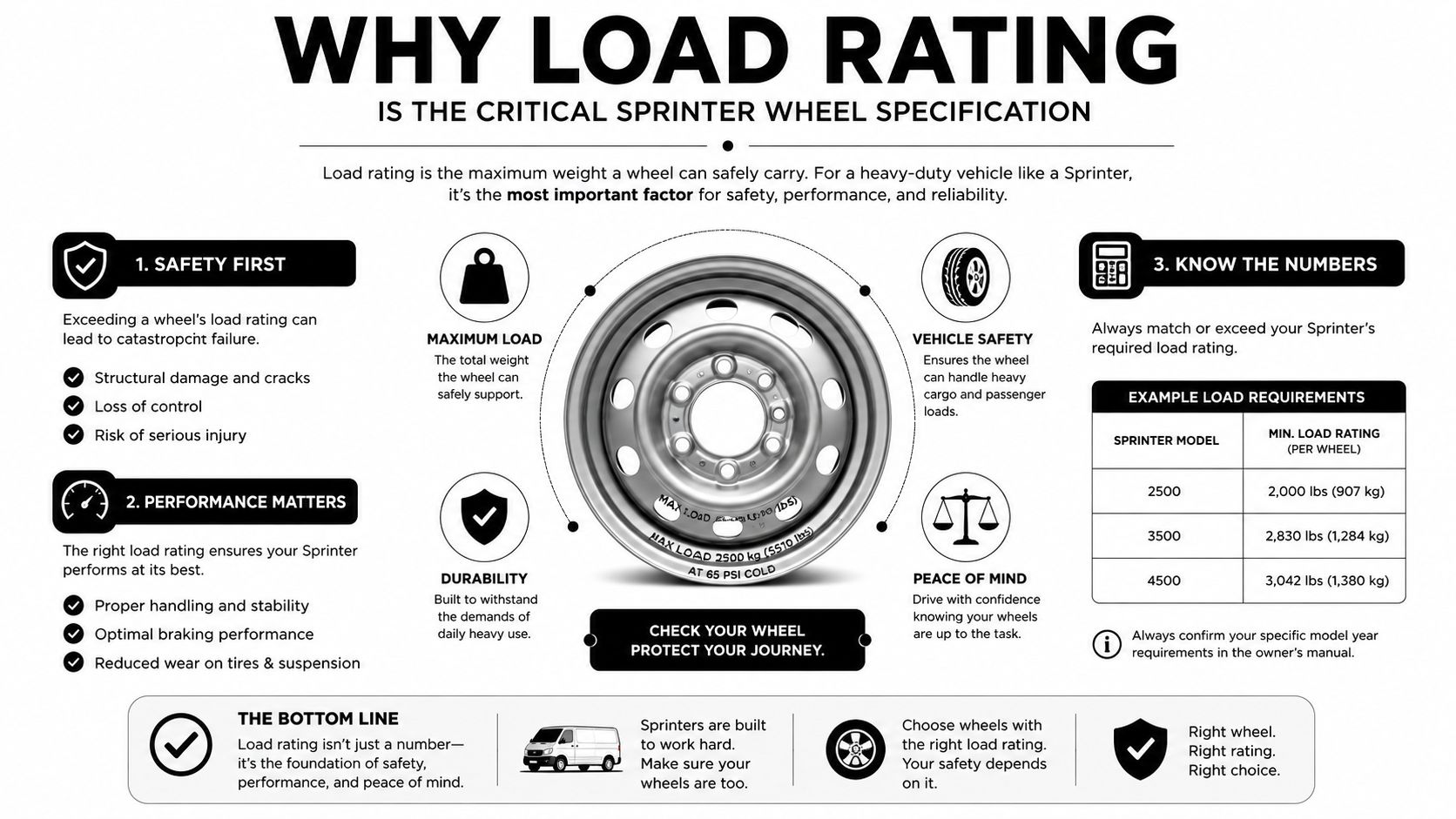
A Sprinter wheel carries commercial payloads, so its load rating matters more than the visual design. Load rating is the maximum load stated for one wheel, expressed in kilograms. UK listings for 6×130 Sprinter and Crafter fitments include TUV-approved alloy wheels rated up to 1,350 kg per wheel.
That figure provides a useful UK market reference, but it isn't a universal requirement for every Sprinter. The correct rating depends on the vehicle's permitted axle loads and the wheel's approved application. Read the wheel marking or technical certificate, then compare it with the vehicle's identification plate and manufacturer specification.
What to verify before buying
- Wheel load rating: It must cover the relevant axle requirement at each corner.
- Vehicle weight class: A 5-tonne Sprinter may have restrictions that don't apply to a lighter variant.
- Approved fitment: The wheel should be identified for the correct PCD, chassis and application.
- Documentation: Ask for the wheel's load information rather than relying on a spoke design or passenger-car appearance.
Mercedes-Benz UK's brochure lists official 16 inch light alloy wheels at £85.00 ex VAT, £102.00 inc VAT, and 17 inch options at £1,045.00 ex VAT, £1,254.00 inc VAT. The same information notes that these options aren't available on 5-tonne models. Those figures are manufacturer brochure prices, not a quotation for a replacement set, and they reinforce the difference between commercial wheel selection and ordinary passenger-car alloy buying.
An under-rated wheel can be structurally unsuitable for the vehicle's permitted load. Don't choose a Mercedes Sprinter alloy wheel until the load rating has been checked against the exact variant.
Can one replacement Sprinter alloy wheel match an existing set
Yes, a single genuine OEM wheel can be the sensible replacement when one wheel is cracked, badly buckled or damaged beyond appropriate repair. Matching requires more than the same diameter and spoke pattern. Check the OE part number, PCD, offset, centre bore, width and finish.
The part number is often stamped on the inner barrel or rear face of the wheel. Photograph that marking, along with the front design and any casting or load information. A registration or VIN helps confirm the vehicle, but the wheel marking remains valuable when the set has been changed during the vehicle's life.
Single wheel or complete set
| Situation | Usually sensible approach |
|---|---|
| One wheel is structurally sound but badly damaged | Source one matching genuine OEM replacement |
| One wheel is beyond repair and the other three are presentable | Replace the damaged wheel, then assess finish consistency |
| The remaining wheels show widespread corrosion or lacquer failure | Consider refurbishment of the complete set |
| The vehicle is changing from steel to factory alloy wheels | Source a verified matching set and confirm all fitment data |
A new wheel can look sharper than three older wheels, particularly where the originals have faded, oxidised or suffered finish loss. Diamond cut faces can be especially difficult to match visually after use. In that situation, refurbishing the full set may produce a more consistent result than fitting one unused wheel.
TPMS sensor transfer, valve condition and balancing should be included in the fitting discussion. The Alloy Hub can supply genuine OEM Mercedes-Benz wheels individually or as sets, subject to fitment confirmation. For current stock and vehicle matching, use the Mercedes-Benz alloy wheel range.
Which finish suits Sprinter alloys, powder coated or diamond cut
Commercial use is hard on wheel finishes. Loading bays, kerbs, road salt and repeated washing can expose weak points in the coating, especially where the surface has already been damaged. The choice between powder coating and diamond cutting should reflect the van's working environment rather than appearance alone.
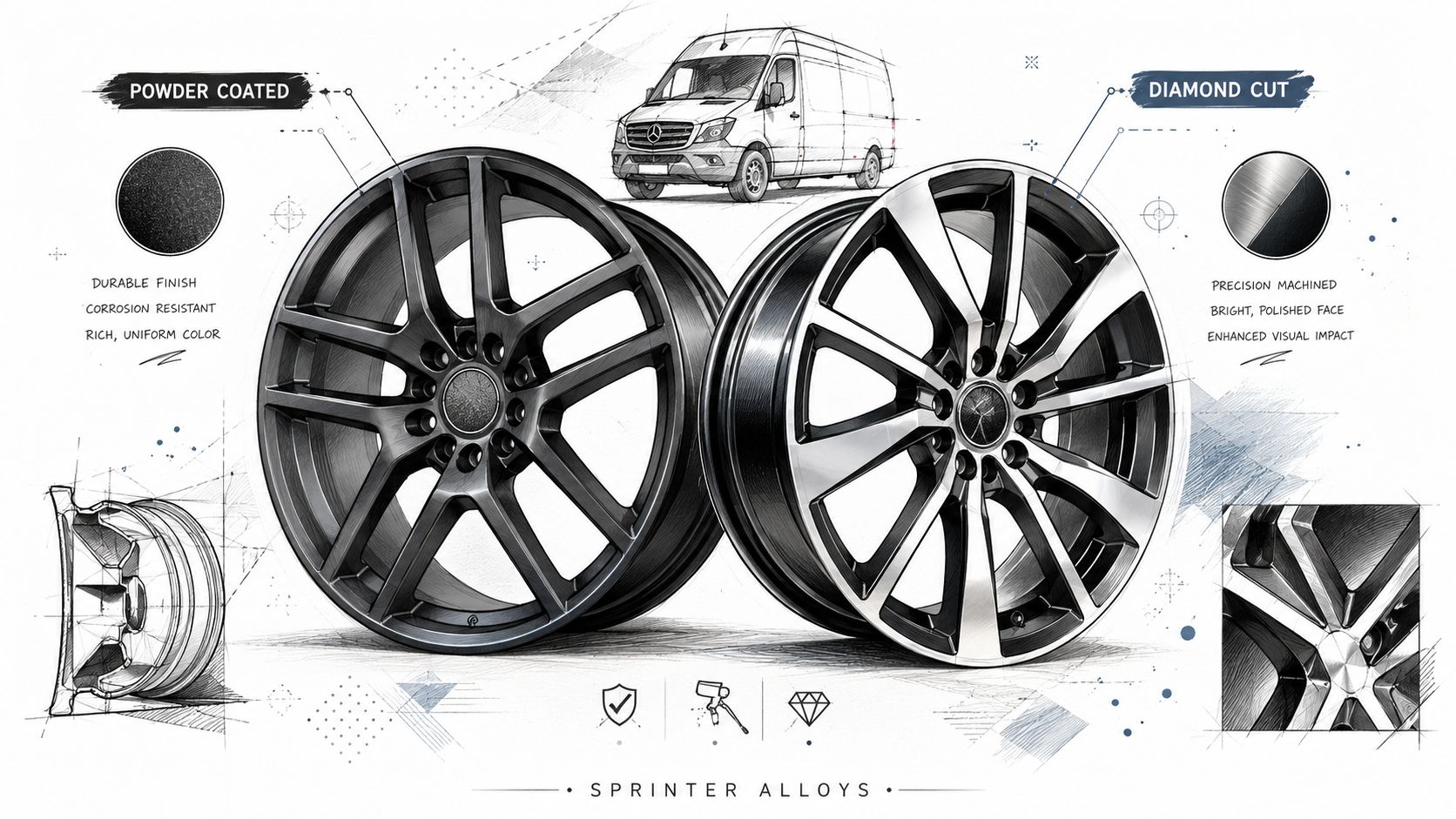
Powder coating applies a durable coated finish across the wheel. It suits owners who want a consistent colour and a surface designed for regular commercial use. Colour changes are also possible when the original silver finish no longer suits the vehicle.
Diamond cutting machines the visible face to create a bright contrast, then protects that face with lacquer. The finish can look sharp when new, but lacquer failure allows moisture to reach the cut surface. Once corrosion develops beneath the lacquer, a local visual repair usually won't produce the same result as properly processing the wheel.
Choosing the finish
| Finish | Visual character | Practical consideration |
|---|---|---|
| Powder coated | Solid, even colour | Suitable for a consistent, durable commercial finish |
| Diamond cut | Bright machined face | More dependent on lacquer condition and moisture exclusion |
| Refurbished colour change | Updated appearance | Requires the complete wheel set to be assessed for damage and corrosion |
Wheels of this design are refinished at The Alloy Hub's Staffordshire powder coating facility, where powder coating and diamond cut work are handled as wheel refurbishment services. See the diamond cut alloy wheel service when deciding whether the existing finish should be restored or replaced.
What Sprinter alloy wheel fitment mistakes should you avoid
The common errors are predictable because Sprinter fitment data varies by generation and chassis. The most expensive mistake is buying on appearance, then discovering the wheel has the wrong PCD, offset or load rating.
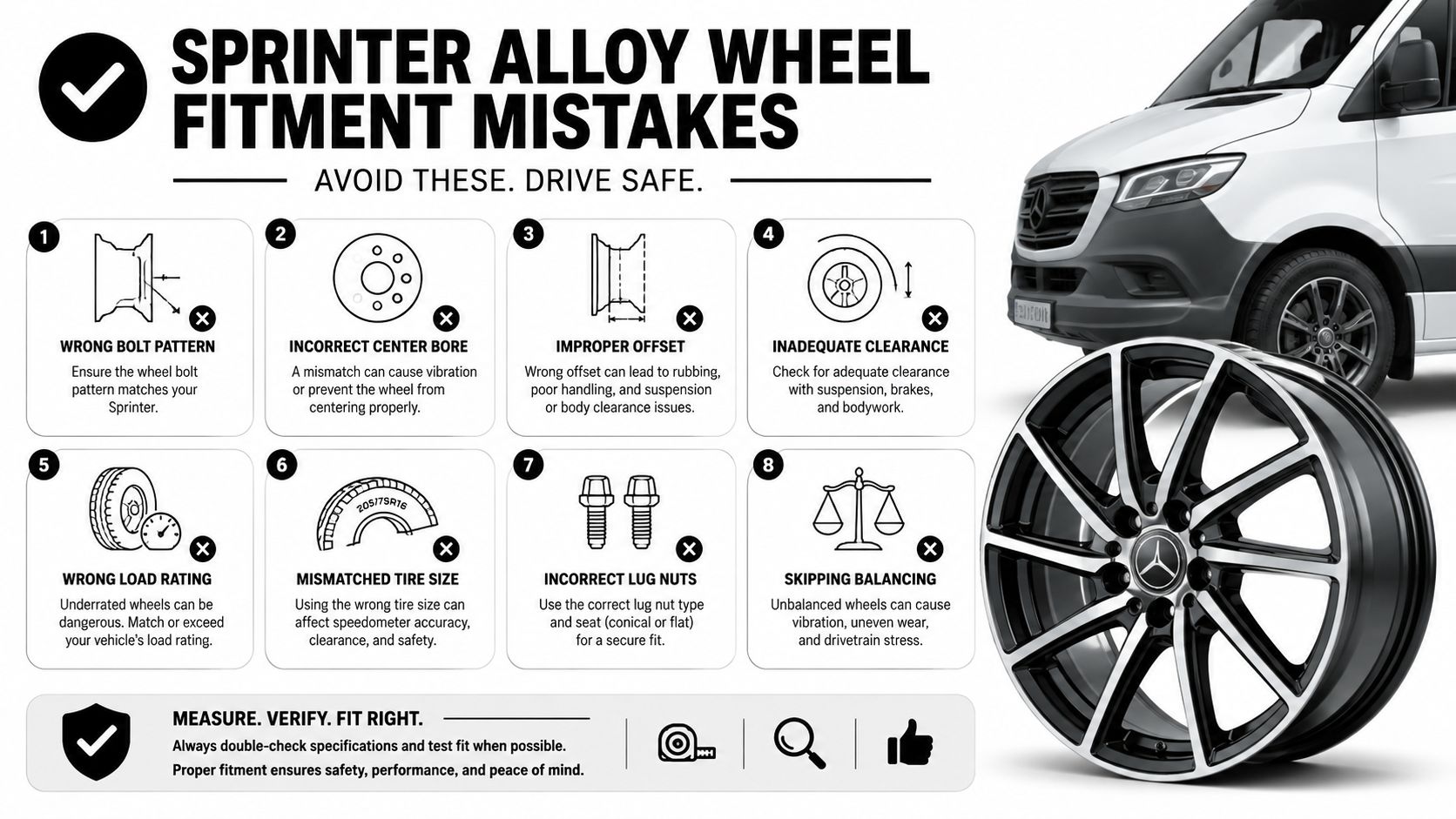
| Mistake | Check that prevents it |
|---|---|
| Confusing 6×130 with 6×205 | Confirm the PCD from the vehicle and wheel records |
| Treating all 16 inch wheels as interchangeable | Check generation, width, ET, centre bore and load rating |
| Fitting a passenger-car alloy | Confirm the wheel is approved for Sprinter payload requirements |
| Ignoring offset | Compare the proposed ET with the chassis-specific fitment |
| Assuming the finish will match an older set | Photograph the existing wheels and assess the complete set |
| Forgetting TPMS transfer | Include sensor compatibility in the fitting enquiry |
Use the VIN, door jamb information and markings on the existing wheel as a combined check. No single visual clue confirms fitment. An identical looking wheel from another model year can have a different offset, centre bore or load capacity.
The correct process is simple: identify the chassis, confirm PCD, record the wheel dimensions, check load rating and then review finish and condition. That order prevents styling decisions from hiding a technical mismatch.
How can you source genuine OEM Sprinter alloy wheels
Start with the information that identifies the wheel, not the colour you want. Gather the Sprinter chassis code, PCD, desired diameter, wheel width, ET and OE part number if it is available. Photographs of the front and inner barrel are useful when a single wheel needs to match an existing set.
A single replacement may be appropriate for one damaged wheel. A complete set makes more sense for a factory alloy upgrade or when the remaining wheels have widespread corrosion. Existing wheels may also be considered for trade in, depending on condition and identification.
The Alloy Hub supplies genuine OEM Mercedes-Benz alloy wheels, including individual wheels and sets, with UK nationwide delivery and worldwide export. To discuss a Sprinter wheel replacement or refurbishment, contact the team on 0330 133 8271 or use the wheel finder to begin the fitment check.
Frequently asked questions
Do all W907 and W910 Sprinters use the same bolt pattern
No. W907 and W910 Sprinters use 6×130 and 6×205 patterns across different applications. Confirm the exact chassis and wheel specification before ordering. The model generation alone doesn't establish the correct PCD.
Are 17 inch alloy wheels factory available for a Sprinter
Yes. The W907/W910 generation expanded factory wheel availability to include 17 inch aluminium wheels alongside 15 inch and 16 inch options. Availability still depends on the vehicle variant, and certain options aren't available on 5-tonne models.
What does 6.5Jx16 ET62 mean on a Sprinter wheel
6.5J identifies the rim width and profile, 16 is the wheel diameter in inches and ET62 is the positive offset in millimetres. The complete fitment still requires the correct PCD, centre bore and load rating.
Can I refurbish one Sprinter alloy wheel
You can refurbish one wheel, but finish consistency needs checking against the other three. Older diamond cut or painted wheels may have changed colour or developed corrosion. A full set refurbishment can provide a more uniform result where wear is widespread.
Can The Alloy Hub supply a single Mercedes Sprinter wheel
The Alloy Hub supplies genuine OEM Mercedes-Benz wheels as singles and sets, subject to identification and fitment confirmation. Provide the vehicle details, wheel measurements and OE part number where available. The team can then assess whether one replacement or a complete set is appropriate.
{ “@context”: “https://schema.org”, “@type”: “BlogPosting”, “headline”: “Alloy Wheels Mercedes Sprinter: Sizes, Fitment & Load”, “description”: “Check Mercedes Sprinter alloy wheel sizes, 5×130, 6×130 and 6×205 PCDs, offsets, centre bore and load ratings before buying OEM wheels.”, “author”: { “@type”: “Organization”, “name”: “The Alloy Hub Ltd.” }, “publisher”: { “@type”: “Organization”, “name”: “The Alloy Hub Ltd.” }, “mainEntityOfPage”: { “@type”: “WebPage” } }{ “@context”: “https://schema.org”, “@type”: “FAQPage”, “mainEntity”: [ { “@type”: “Question”, “name”: “Do all W907 and W910 Sprinters use the same bolt pattern”, “acceptedAnswer”: { “@type”: “Answer”, “text”: “No. W907 and W910 Sprinters use 6×130 and 6×205 patterns across different applications. Confirm the exact chassis and wheel specification before ordering. The model generation alone doesn’t establish the correct PCD.” } }, { “@type”: “Question”, “name”: “Are 17 inch alloy wheels factory available for a Sprinter”, “acceptedAnswer”: { “@type”: “Answer”, “text”: “Yes. The W907/W910 generation expanded factory wheel availability to include 17 inch aluminium wheels alongside 15 inch and 16 inch options. Availability still depends on the vehicle variant, and certain options aren’t available on 5-tonne models.” } }, { “@type”: “Question”, “name”: “What does 6.5Jx16 ET62 mean on a Sprinter wheel”, “acceptedAnswer”: { “@type”: “Answer”, “text”: “6.5J identifies the rim width and profile, 16 is the wheel diameter in inches and ET62 is the positive offset in millimetres. The complete fitment still requires the correct PCD, centre bore and load rating.” } }, { “@type”: “Question”, “name”: “Can I refurbish one Sprinter alloy wheel”, “acceptedAnswer”: { “@type”: “Answer”, “text”: “You can refurbish one wheel, but finish consistency needs checking against the other three. Older diamond cut or painted wheels may have changed colour or developed corrosion. A full set refurbishment can provide a more uniform result where wear is widespread.” } }, { “@type”: “Question”, “name”: “Can The Alloy Hub supply a single Mercedes Sprinter wheel”, “acceptedAnswer”: { “@type”: “Answer”, “text”: “The Alloy Hub supplies genuine OEM Mercedes-Benz wheels as singles and sets, subject to identification and fitment confirmation. Provide the vehicle details, wheel measurements and OE part number where available. The team can then assess whether one replacement or a complete set is appropriate.” } } ] }For a confirmed Mercedes Sprinter alloy wheel replacement, The Alloy Hub Ltd. can identify genuine OEM singles or sets and assess whether damaged wheels are suitable for refurbishment and powder coating. Visit The Alloy Hub Ltd. with your Sprinter details or call 0330 133 8271 to discuss the correct PCD, offset and load rating.