A bent alloy wheel is not just a cosmetic flaw, it can change how the wheel runs, seat, and clamp to the hub. In the UK, around 33% of cars are said to be driven with damaged alloy wheels and an estimated £890 million is needed each year to fix that damage, with potholes and kerbing doing most of the harm, so straightening is a routine structural repair, not a rare one. UK wheel damage and repair demand
Table of Contents
- What Alloy Wheel Straightening Fixes
- How Professional Wheel Straightening Works
- When to Straighten a 20 Inch BMW Wheel Versus Replace It
- How Straightening Affects Diamond Cut and Powder Coated Finishes
- Finding Qualified Alloy Wheel Straightening Specialists
- Common Questions About Wheel Straightening and Safety
What Alloy Wheel Straightening Fixes
A wheel straightener corrects buckle, bend, and flat spot damage where the wheel has lost true running. It does not make a cracked wheel safe, and it does not turn heavy structural deformation into a cosmetic issue. The job is to bring the wheel back within safe shape limits so the tyre seats properly and the wheel rotates without obvious runout.
Damage that changes shape, not just appearance
Cosmetic damage is surface only, kerbing marks, lacquer failure, staining, and shallow scuffs. Straightening deals with deformation in the metal itself, usually caused by pothole strikes, kerbing, or repeated impacts over poor road surfaces. If you want a quick guide to the warning signs, these signs of a buckled alloy wheel are a useful check before any repair quote.
A wheel can look acceptable and still be unsafe. If the wheel no longer runs true, it needs measurement before anyone talks about finish. That distinction matters because minor, localised damage can often be brought back into shape, while a crack or major fracture means replacement is the correct route. Alloy wheel repair limits
A wheel that looks slightly out of round can still be a structural problem. If the wheel no longer runs true, it needs measurement before anyone talks about finish.
How Professional Wheel Straightening Works
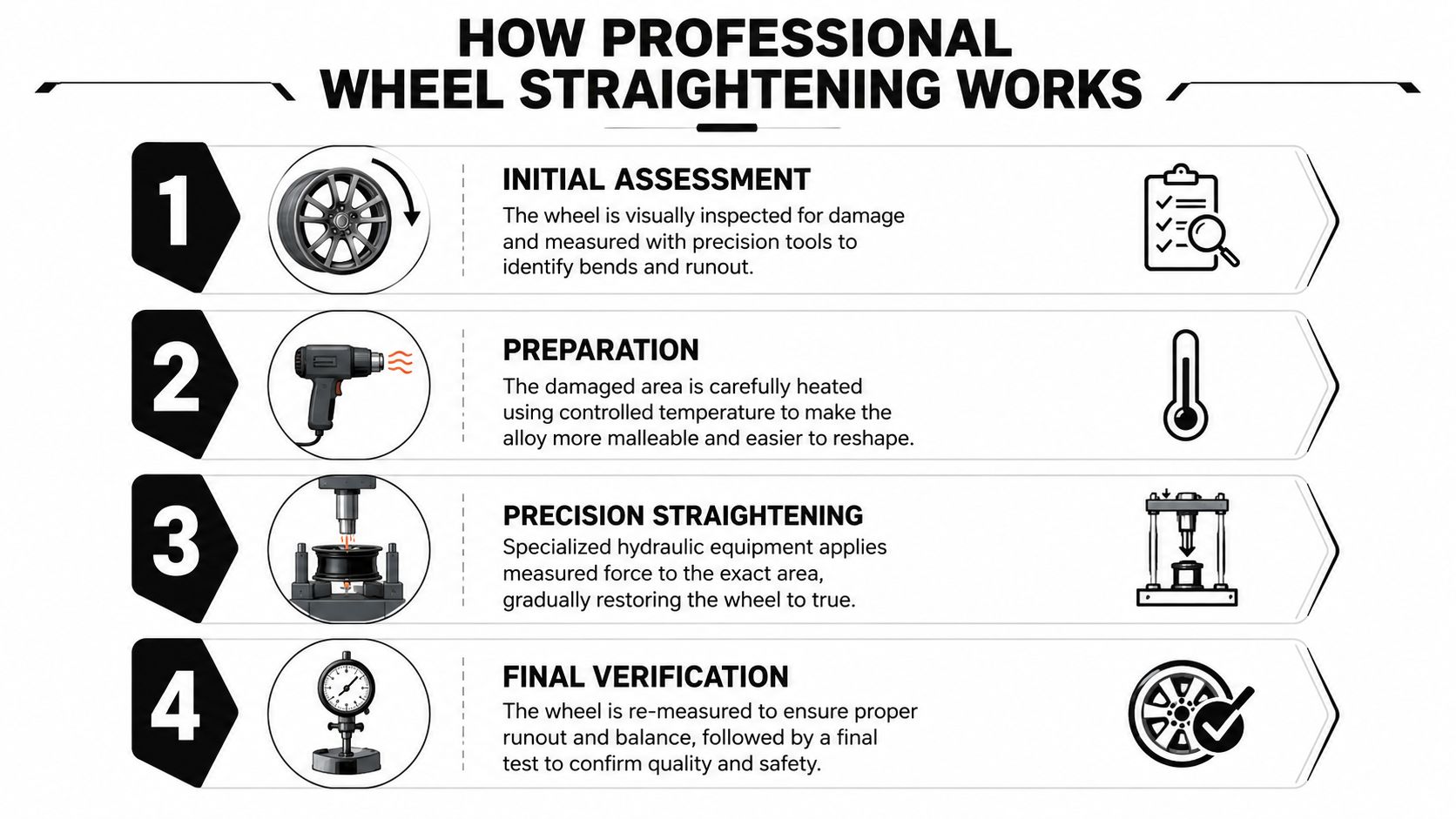
Straightening starts with the wheel removed from the car and stripped of the tyre. The technician measures runout, checks the rim profile, and decides whether the distortion is local enough to correct without pushing the metal past a safe limit. That judgement sits within the IMI alloy wheel repair standard and, in practice, separates a repairable bend from a wheel that should be replaced.
Controlled heat, measured force, final verification
The work belongs in a workshop. Controlled heating, proper presses, and repeat measurement are part of the process, because alloy moves under load and can spring back in ways that are not obvious at first sight. If the wheel is being handled to standard, the repairer should also use suitable personal protective equipment and protect the vehicle where needed.
The end check matters as much as the correction. The wheel should be measured again for true running before it goes back on the car, and the refit needs the same care as the straightening itself. IMI wheel repair standard
Practical rule: if the repairer cannot explain how they measure the wheel before and after straightening, walk away.
Refitting has its own risks. GOV.UK wheel refitting guidance says to use a calibrated torque wrench, tighten to the maker's specified torque in the correct sequence, and recheck the wheel fixings after 30 minutes stationary or within 25 to 50 miles of use. It also warns against relying on power tools or long bars for final tightening.
When to Straighten a 20 Inch BMW Wheel Versus Replace It
A 20 inch BMW wheel is a good example because the wheel value often justifies a repair, but only if the structure is still sound. Straightening makes sense when the damage is a bend, buckle, or flat spot and the wheel can be returned to true running without chasing thin metal or hidden cracking. A cracked wheel, or one with major distortion, should be replaced.
| Damage Type | Repairable | Action Required |
|---|---|---|
| Light bend or buckle | Yes | Straighten and remeasure |
| Flat spot from impact | Yes | Straighten if structure is intact |
| Crack in the wheel | No | Replace the wheel |
| Major fracture or severe deformation | No | Replace the wheel |
This decision matters for roadworthiness as well as appearance. UK repair guidance treats a cracked, severely distorted, or poorly repaired wheel as an immediate MOT failure condition, so the question is never just whether the wheel can be made to look better. The question is whether it can safely carry load again. IMI alloy wheel standard
Typical UK refurbishment pricing gives context without pretending to quote a straightening job. Checkatrade lists a single wheel up to 20 inches at around £80 and a full set at around £300, with larger 21 inch plus wheels around £90 each and about £340 for a full set. Those figures help frame the trade off between correction and replacement work, but a premium OEM wheel with structural damage still needs an inspection against safety limits. Typical UK alloy wheel refurbishment costs
The Alloy Hub also publishes guidance on refurbishment cost and wheel replacement decisions, which is useful when you're deciding whether a bent wheel is worth saving or should be replaced through a genuine OEM route. Alloy wheel repair and refurbishment cost guidance
How Straightening Affects Diamond Cut and Powder Coated Finishes
Straightening only corrects shape. It does not restore a damaged face finish, and that is where owners get caught out. A wheel can be brought back true and still need cosmetic work if the finish was already compromised, or if machining and handling have marked the surface.
Diamond cut faces need careful follow on work
A proper diamond cut repair starts with tyre and wheel removal, then CNC lathe machining of only about 0.2 to 0.5 mm from the face, followed by relacquering and force curing. Most wheels can only be recut 2 to 3 times before the face becomes too thin for further cutting. That limit matters because a straightened diamond cut wheel may still be sound enough to use, but no longer suitable for repeated re-machining. See the diamond cut wheel machine process alongside Diamond cut wheel repair guidance.
Powder coated wheels behave differently because the finish is more forgiving than a machined face, but the wheel still needs a proper workshop process. On a bent wheel, the correct decision is not just whether the finish can be touched in, but whether the metal will hold its shape safely after repair. Wheel refurbishment and straightening should be judged together, then weighed against replacement if the wheel has already been repaired, the coating is badly damaged, or the structure is close to its limit.
If a wheel has been straightened once and the face finish is already thin or damaged, replacement can be the safer and cleaner option than chasing another cosmetic save.
Finding Qualified Alloy Wheel Straightening Specialists
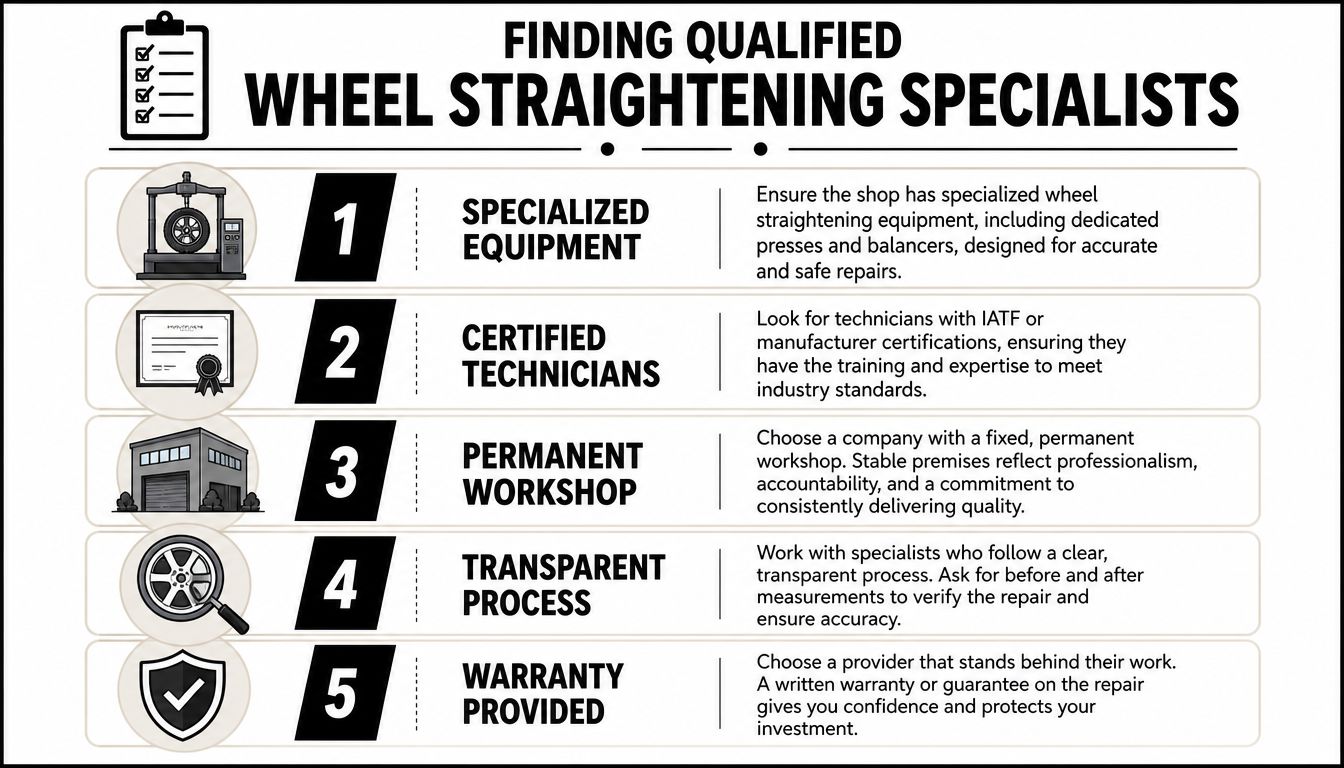
A bent wheel is only safe to straighten if the workshop can show where the limit is. Look for a fixed workshop with proper measuring gear, not a cosmetic operator who treats straightening as an add-on. The repairer should explain inspection, measurement, and refitting in plain terms, and should say when replacement is the better call. If they avoid that question, they are not giving you a proper safety answer.
What to verify before you book
Ask for before and after measurements, and ask how the wheel is refitted with the correct torque sequence. You also want to know whether the wheel is checked again after initial use, because a straightened wheel that has not been rechecked can still show movement under load.
For dealers and garages, a booking workflow matters too. A service such as find an AI receptionist for dealers can help route customer enquiries, but the technical answer still has to come from the wheel specialist, not the software. Keep the conversation on runout, crack checks, and replacement thresholds.
The decision is structural, not cosmetic. If a specialist can explain why a wheel is repairable, and where it crosses into OEM replacement, you are speaking to someone who understands safety limits as well as finish quality.
Common Questions About Wheel Straightening and Safety
Straightened wheels can be safe for normal road use if the wheel was repairable in the first place and the workshop has verified the result. They should not be treated as acceptable if the wheel is cracked or badly distorted. If the wheel has been straightened more than once, ask whether the face thickness and structural condition still leave enough material for a safe repair.
A straightening job should last if the wheel is used within normal limits and fitted correctly. Bad refitting can undo good repair work, so torque control matters. Insurance or claim processes may ask for photos, an invoice, and a mechanic's statement if the damage came from a pothole, but the repair decision still comes back to the wheel's structure, not just the paperwork.
The Alloy Hub Ltd. supplies genuine OEM alloy wheels and carries out refurbishment work, including wheel straightening where the wheel is repairable and replacement where it is not. If you need a straight answer on a bent BMW wheel, a damaged set, or a single OEM replacement, visit The Alloy Hub Ltd. or call 0330 133 8271.