A diamond cut wheels machine removes approximately 0.5 to 0.6 mm from the wheel face during a pass. It's a CNC lathe, not a surface coating system, so that finite removal depth limits how many times a genuine alloy wheel can safely be re-cut.
That's the point many owners miss. A fresh diamond cut finish looks close to a factory two-tone face, but the machine achieves it by removing material from the aluminium. The wheel's condition, previous cuts and corrosion therefore matter as much as the visible kerb damage.
Table of Contents
- What a diamond cut wheels machine actually does
- How precision scanning and material removal work on a 22 inch BMW wheel
- Diamond cutting versus powder coating for Audi alloy refurbishment
- How many times can a Land Rover diamond cut wheel be re-cut
- Quality indicators when buying a refurbished 20 inch Mercedes Benz diamond cut wheel
- When to refurbish and when to replace your diamond cut alloys
What a diamond cut wheels machine actually does
A diamond cut wheels machine clamps the alloy wheel to a CNC lathe and rotates it while a programmed cutting tool follows the wheel's face profile. The tool removes a thin layer of painted surface or aluminium, exposing a bright metal finish. A lacquer is then applied to help protect the exposed face from corrosion, as described in this wheel refurbishment process guide.
The process is controlled machining. It isn't a cosmetic coating laid over damage. The wheel must be mounted accurately, the face must be scanned and the cutting path must follow the original profile. If the operator removes too much material, the wheel can lose part of its factory face detail and may not have sufficient surface left for another cut later.
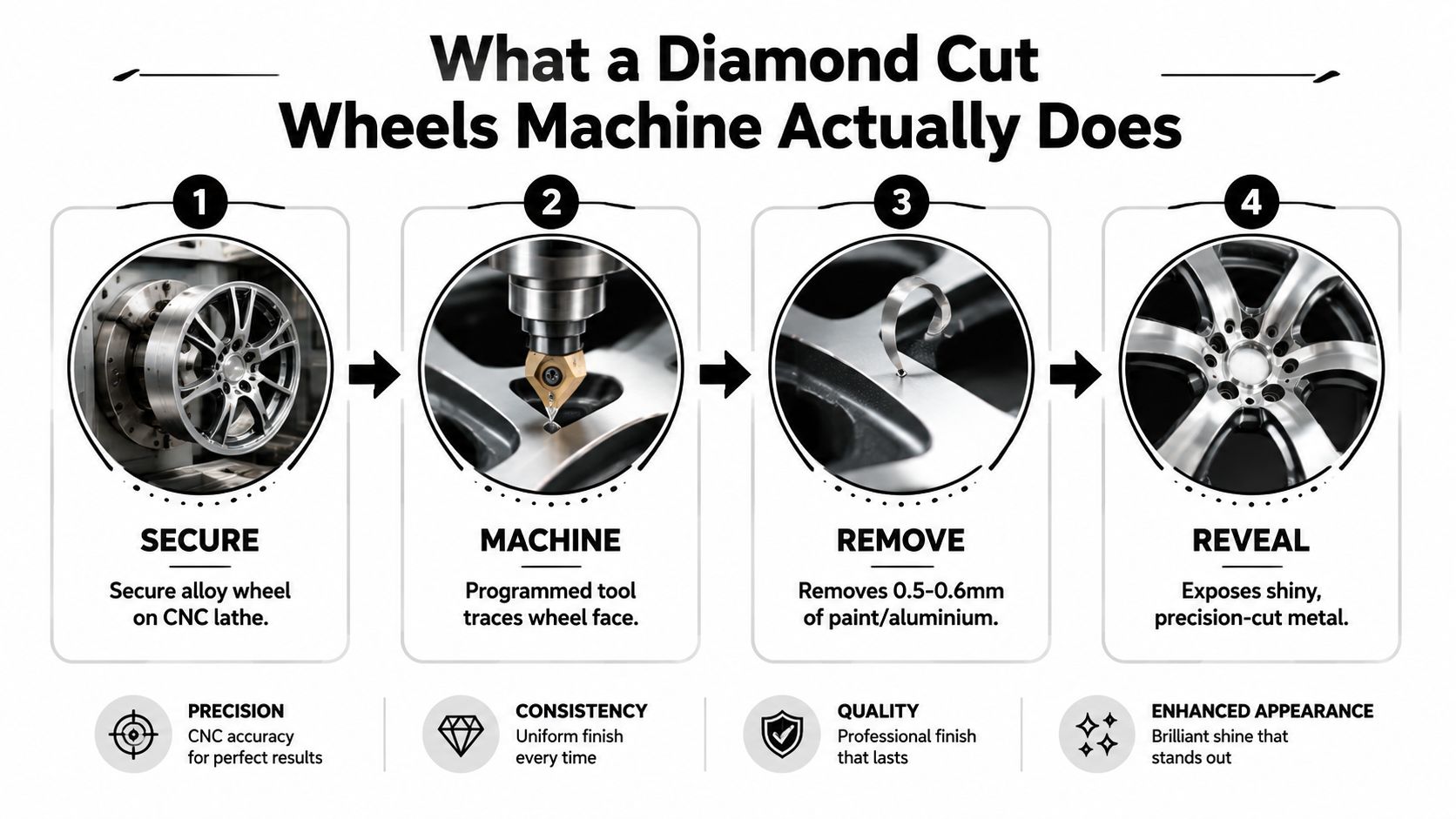
The usual result is a two-tone finish. The machined face has a metallic lustre while the barrel and recessed areas retain a painted colour. Powder coating is different because it applies an electrostatically charged dry powder to a grounded wheel before heat curing. The distinction matters if you're deciding whether to restore the original finish or change the wheel colour.
Practical rule: A diamond cut wheel should be assessed as a machined component, not treated like a painted panel.
The Alloy Hub documents the stages involved in professional alloy wheel refurbishment. That approach is particularly relevant where the face has failed lacquer, light kerb damage or corrosion that hasn't removed too much of the original surface.
How precision scanning and material removal work on a 22 inch BMW wheel
A diamond cut machine cannot recreate a wheel face accurately until it has recorded the existing profile. On the Wheel Restore diamond cut machine platform, the published specification states laser scanning accuracy below 0.01 mm and a cutting cycle of about 15 minutes per wheel according to its published machine specification. The same specification lists the platform's electrical supply, spindle capacity, axis travel and wheel-size range.
| Specification | Published value | What it means in practice |
|---|---|---|
| Electrical supply | 230/110 V, 16 A | The workshop needs a compatible electrical connection |
| Average spindle motor | 1.1 kW | Supplies the normal cutting drive |
| Peak spindle motor | Up to 3 kW | Provides extra capacity when cutting resistance increases |
| X-axis travel | 655 mm | Allows the tool to move across the wheel face |
| Z-axis travel | 350 mm | Controls the tool's movement through the cutting area |
| Maximum wheel diameter | 30 inches | Covers wheels up to the platform's stated size limit |
| Laser accuracy | Below 0.01 mm | Supports accurate profile recording before machining |
| Cycle time | About 15 minutes per wheel | Indicates machine cutting time, not the complete refurbishment |
Laser scanning records the shape for the cutting path. It does not add material or correct a wheel that has already lost too much of its face. Concentricity means the machined surface remains aligned with the wheel's centre as it rotates, so mounting accuracy and operator setup still affect the result.
A 22 inch BMW wheel is within the platform's stated diameter range. That does not automatically make it suitable for another cut. The operator should inspect the face, check for cracks or distortion, measure the remaining profile and identify any earlier machining. Kerb damage can often be removed, but every cut reduces the aluminium available for future refurbishment.
The spindle figures need the same practical reading. A motor rated up to 3 kW does not make an over-machined or structurally damaged wheel safe. The machine's useful advantage is repeatable control, accurate sensing and a programmed path that removes only the material needed to restore the intended geometry. If the remaining face is too thin or the profile has already been altered substantially, replacement may be the safer decision.
Diamond cutting versus powder coating for Audi alloy refurbishment
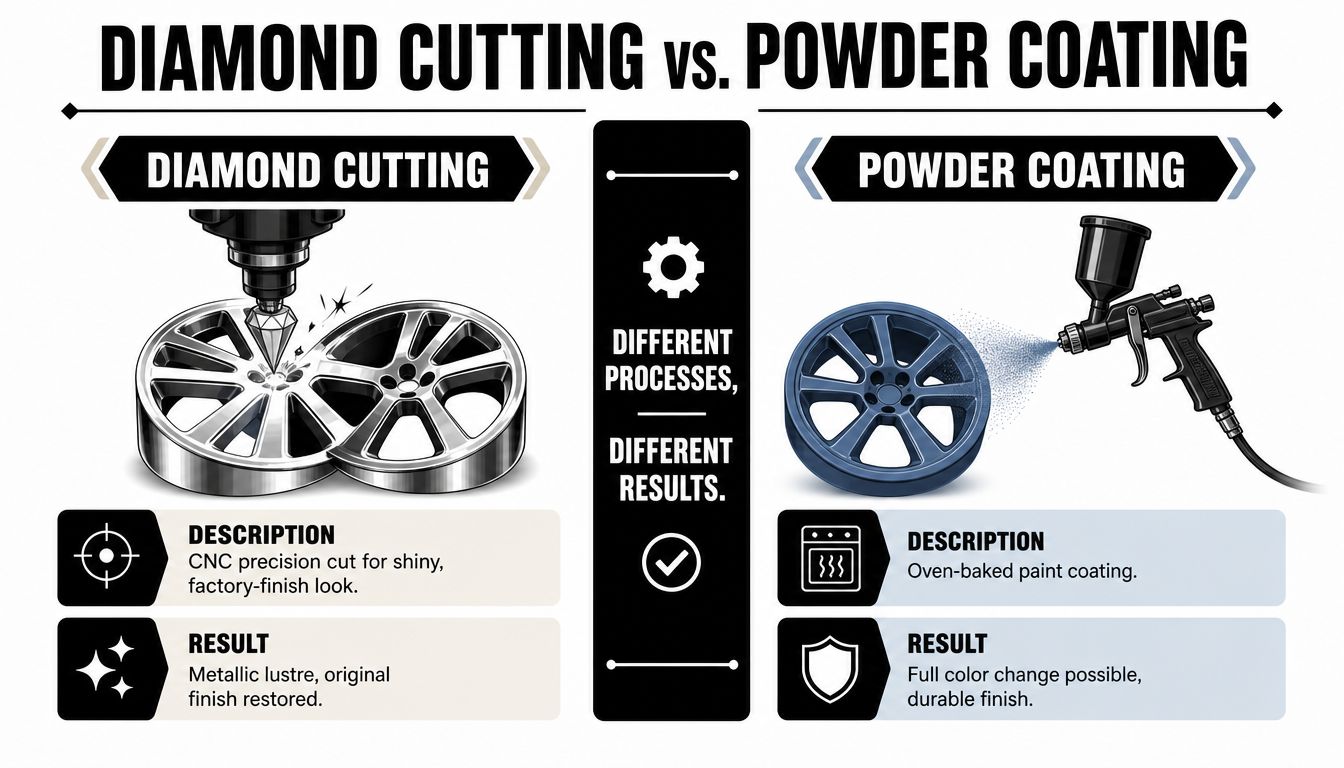
Diamond cutting is limited by the aluminium left on the face. Powder coating avoids repeated face cuts by stripping the existing finish and building a new cured coating over the prepared wheel. The two processes therefore suit different damage and finish requirements.
Diamond cutting machines the visible face to expose bright aluminium, then protects it with lacquer. Powder coating typically involves stripping the old finish, blasting the surface, applying powder primer and colour, then oven curing the coating. The powder is electrostatically charged so it adheres to the grounded wheel before heat curing, as set out in this powder coating process explanation.
| Wheel condition or objective | More suitable route | Reason |
|---|---|---|
| Failed lacquer on the machined face | Diamond cutting, subject to inspection | The damaged face may need a light cut before fresh lacquer |
| Scuffed painted finish | Powder coating | The wheel can be stripped and refinished in a new colour |
| Desire for a full colour change | Powder coating | A complete new coating can cover the prepared wheel |
| Original two-tone appearance | Diamond cutting with compatible painted areas | The face and barrel can be refinished as separate stages |
| Excessive previous face removal | Replacement may be safer | Another cut reduces the remaining material further |
For a detailed comparison of both finishes, see our guide on powder coating versus diamond cutting for Audi alloys.
A wheel can use both processes. The barrel and recessed areas may receive powder coating while the face is diamond cut to recreate the contrasting factory appearance. Wheels of this type are refinished at The Alloy Hub's Staffordshire powder coating facility, with the route selected according to the wheel's condition and original finish.
Published UK service guidance gives different expected windows, with standard powder coating usually taking 1 to 2 days and diamond cut repair taking 2 to 5 days in this refurbishment turnaround guide. These are typical service windows, not a quotation or promise for a particular wheel.
How many times can a Land Rover diamond cut wheel be re-cut
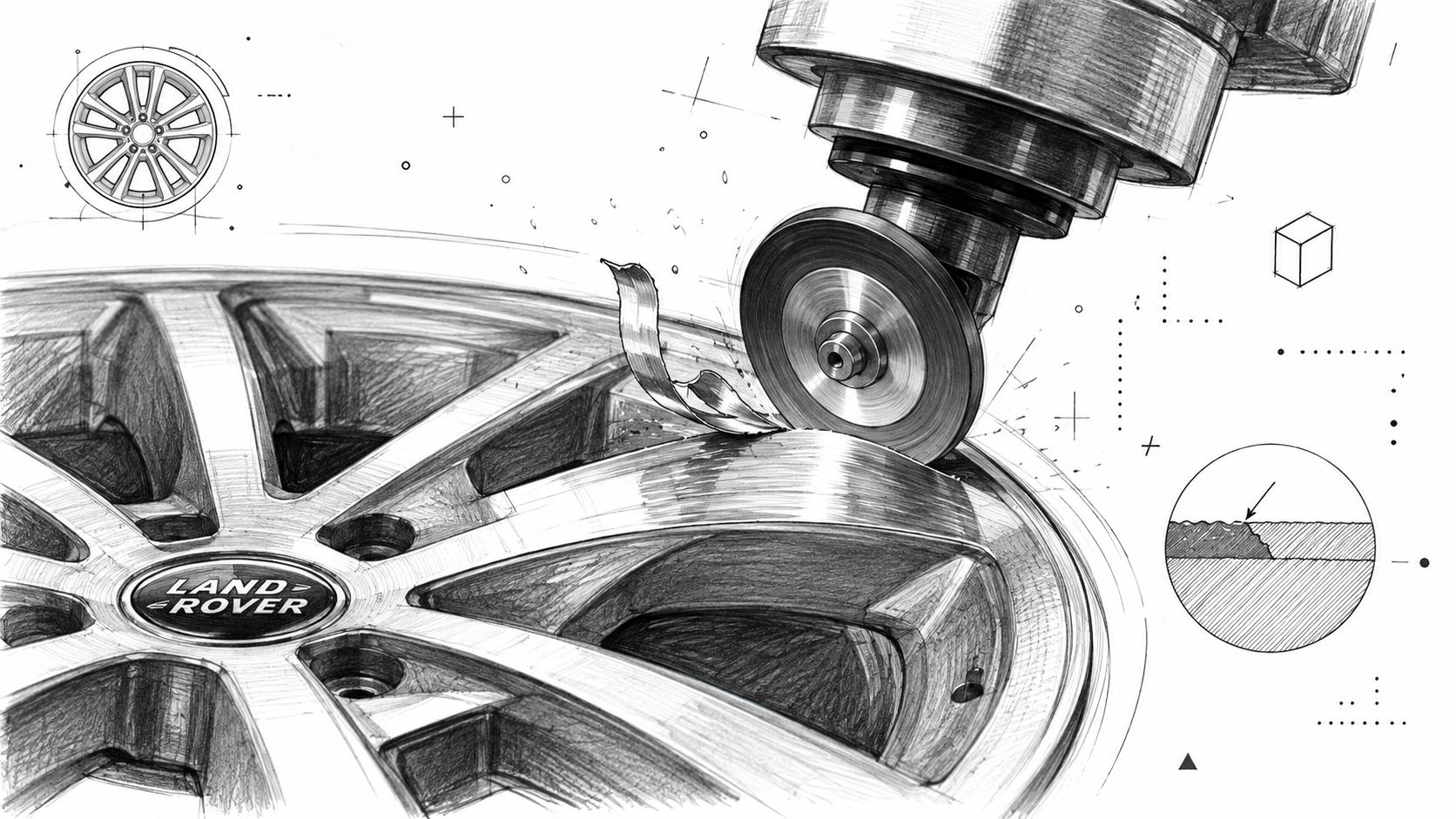
There is no fixed safe number of re-cuts for every Land Rover wheel. The diamond cut wheels machine removes a thin layer from the face to restore the machined finish, so every pass reduces the material available for future repairs. The remaining thickness, wheel profile and previous machining history determine whether another cut is sensible.
The published British manufacturing profile for the DCR Pro lathe describes the process as removing about 0.5 mm, with removal typically around 0.6 mm on average in its published British manufacturing profile. Treat those figures as process guidance rather than a promise for every wheel. The actual cut depends on how much damage must be removed and how the wheel is set up.
A wheel with original face material and light lacquer failure may have a straightforward refurbishment route. Previous cuts, deep corrosion and softened spoke edges reduce that margin. Once the face profile is too low or important detail has been lost, replacement can be safer than another cosmetic cut.
Use this checklist before booking:
- Light lacquer failure: A further cut may be suitable if enough face material remains and the profile is intact.
- Shallow kerb marking: Refinishing may work when the damage does not penetrate into the machined face.
- Heavy corrosion: Request an inspection. Corrosion may require more material removal than the wheel can safely provide.
- Previous machining: Tell the refurbisher whenever the wheel has been diamond cut before. That history changes the assessment.
- Cracks or significant distortion: Replacement is generally the safer route than cosmetic refurbishment.
The benefits of buying genuine Land Rover alloy wheels include a practical replacement route when remaining face material or structural condition rules out another cut. A responsible inspection should separate finish damage from a wheel that should be replaced.
Quality indicators when buying a refurbished 20 inch Mercedes Benz diamond cut wheel
A good 20 inch Mercedes Benz diamond cut wheel should have a consistent face profile and an even metallic finish. The machined lines should follow the design cleanly, without obvious steps, ridges or areas where the cutting depth changes abruptly.
Inspect the outer edges and spoke transitions closely. Over-cutting can soften sharp factory details or leave an edge that doesn't match the surrounding face. The lacquer should appear continuous across the exposed face, with no visible lifting, clouding or unprotected bright aluminium.
Ask the refurbisher four direct questions:
- Has the wheel been diamond cut before? Previous machining affects the available material.
- Was the wheel checked for cracks and distortion? Cosmetic appearance alone doesn't establish suitability.
- Which areas were powder coated and which were machined? The two finishes require different preparation.
- Is the wheel genuine OEM? Consistent factory profiles make identification and finish assessment more straightforward.
The Alloy Hub supplies genuine OEM wheels and carries out diamond cutting at its Staffordshire facility. Genuine OEM sourcing also gives the owner a replacement option if the wheel has reached the point where another face cut isn't sensible.
When to refurbish and when to replace your diamond cut alloys
Refurbishment is usually worth assessing when a genuine OEM wheel has light kerb damage or early lacquer failure and the machined face retains sufficient material. Replacement becomes more sensible where corrosion is deep, previous cuts have reduced the face or inspection identifies structural concerns.
For Tesla, Volkswagen and Range Rover owners, The Alloy Hub supplies genuine OEM replacement wheels as singles or sets, subject to vehicle fitment checks. The business also accepts existing wheels for trade in where appropriate, so a damaged set doesn't automatically have to be discarded.
The Alloy Hub Ltd. supplies genuine OEM alloy wheels and refurbishes suitable wheels with powder coating and diamond cutting, including replacements where another face cut isn't appropriate. Visit The Alloy Hub Ltd. to check your vehicle's wheel options, or call 0330 133 8271 for a fitment and refurbishment assessment.
{ “@context”: “https://schema.org”, “@type”: “BlogPosting”, “headline”: “Diamond Cut Wheels Machine: The Refurbishment Process”, “description”: “A diamond cut wheels machine removes approximately 0.5 to 0.6 mm from an alloy wheel face. Learn how the process works, when re-cutting is safe and when to replace.”, “author”: { “@type”: “Organization”, “name”: “The Alloy Hub Ltd.” }, “publisher”: { “@type”: “Organization”, “name”: “The Alloy Hub Ltd.” }, “mainEntityOfPage”: { “@type”: “WebPage”, “@id”: “https://www.alloyhub.com” } }{ “@context”: “https://schema.org”, “@type”: “FAQPage”, “mainEntity”: [ { “@type”: “Question”, “name”: “Does a diamond cut machine remove aluminium?”, “acceptedAnswer”: { “@type”: “Answer”, “text”: “Yes. The machine removes a thin layer of painted surface or aluminium from the wheel face to expose a bright metal finish. The cut is controlled, but it still uses some of the wheel’s available face material.” } }, { “@type”: “Question”, “name”: “Can every 22 inch BMW wheel be diamond cut?”, “acceptedAnswer”: { “@type”: “Answer”, “text”: “No. Wheel diameter doesn’t confirm suitability. The wheel needs inspection for previous machining, corrosion, cracks, distortion and the amount of material remaining on the face.” } }, { “@type”: “Question”, “name”: “Is powder coating the same as diamond cutting?”, “acceptedAnswer”: { “@type”: “Answer”, “text”: “No. Diamond cutting machines the wheel face to expose aluminium. Powder coating applies a charged dry powder before heat curing. They’re separate processes and can sometimes be used on different areas of the same wheel.” } }, { “@type”: “Question”, “name”: “What happens if a wheel has been diamond cut before?”, “acceptedAnswer”: { “@type”: “Answer”, “text”: “Previous cuts reduce the material available for another pass. The refurbisher should know the wheel’s history and inspect the face before confirming whether another cut is suitable.” } }, { “@type”: “Question”, “name”: “Should I refurbish or replace a corroded Mercedes Benz wheel?”, “acceptedAnswer”: { “@type”: “Answer”, “text”: “It depends on the depth of corrosion, previous machining and the wheel’s structural condition. Light surface deterioration may be suitable for refurbishment, while deep corrosion or structural concerns can make a genuine OEM replacement the safer choice.” } } ] }