£149 to £300 is the realistic UK band for a professional four-caliper respray, and the quote I see most often lands at £299 for all four calipers. Add decals and you're already into extra spend, so the final number depends on the specific work being done, not the headline on the flyer.
That's the right place to start because brake caliper painting cost gets mis-sold all the time. Customers compare a quick wet-spray quote with a proper off-car job, or they compare UK prices with US powder-coating figures, then wonder why the bills don't match. They don't match because the scope doesn't match.
Table of Contents
- What Brake Caliper Painting Actually Costs in the UK
- Brush, Wet-Spray, and Powder Coat Finish Types
- What Is Actually Included in the Price You Are Quoted
- Two Realistic Customer Scenarios Compared
- How the Job Is Actually Done in a Workshop
- Why the Cheapest Quote Often Costs More in the End
- Pairing Caliper Painting with a Wheel Refurbishment
- Your Pre-Booking Checklist for a Quality Caliper Respray
What Brake Caliper Painting Actually Costs in the UK
A proper UK brake caliper painting cost usually sits in a tight band once you strip out the fluff. For a full four-caliper wet-spray job, £299 is a common figure, and custom decals add £25 on top, which works out at about £74.75 per caliper before extras are added (On Track Detailing).
What that baseline actually tells you
That price gives you a solid UK benchmark. It is the cost of a defined cosmetic service, not a vague “starting from” number that leaves out masking, lacquer, or wheel-off labour. If a quote sits well below that level, something has been cut. If it sits above it, ask exactly what you are paying for before you assume the shop is taking the mick.
UK-facing prices also move by axle count. One end of the market is £149 for front calipers only, while the upper end reaches £300 for front and rear calipers. That spread matters because a front-only quote can look cheap while leaving the rear calipers untouched, which rarely gives the clean, finished look most owners want (Specialist Tyres).
Practical rule: compare quotes only after you have checked the same scope, the same finish type, and the same level of prep. Otherwise you are comparing different jobs, not different prices.
The landed cost also changes when caliper painting is treated as part of wheel and refurbishment work rather than a separate cosmetic add-on. A car that is already booked for wheel refurbishment, hub detailing, or a brake clean-down often costs less overall to finish properly than a car booked in for calipers alone, because the labour is being planned around the whole corner of the vehicle. That is where cheap quotes can mislead owners. They price the colour change, then bill separately for the prep and the details that make the job look right.
You also see wider numbers online, especially from the US market. Professional caliper painting is commonly priced around $250 to $450, while powder coating is typically higher at about $175 to $200 per caliper, or $700 to $800 for four, because it needs more labour and high-temperature curing (Paint Strategies). Ignore those overseas figures unless you are also comparing the process and labour content, because the method drives the bill.
Brush, Wet-Spray, and Powder Coat Finish Types
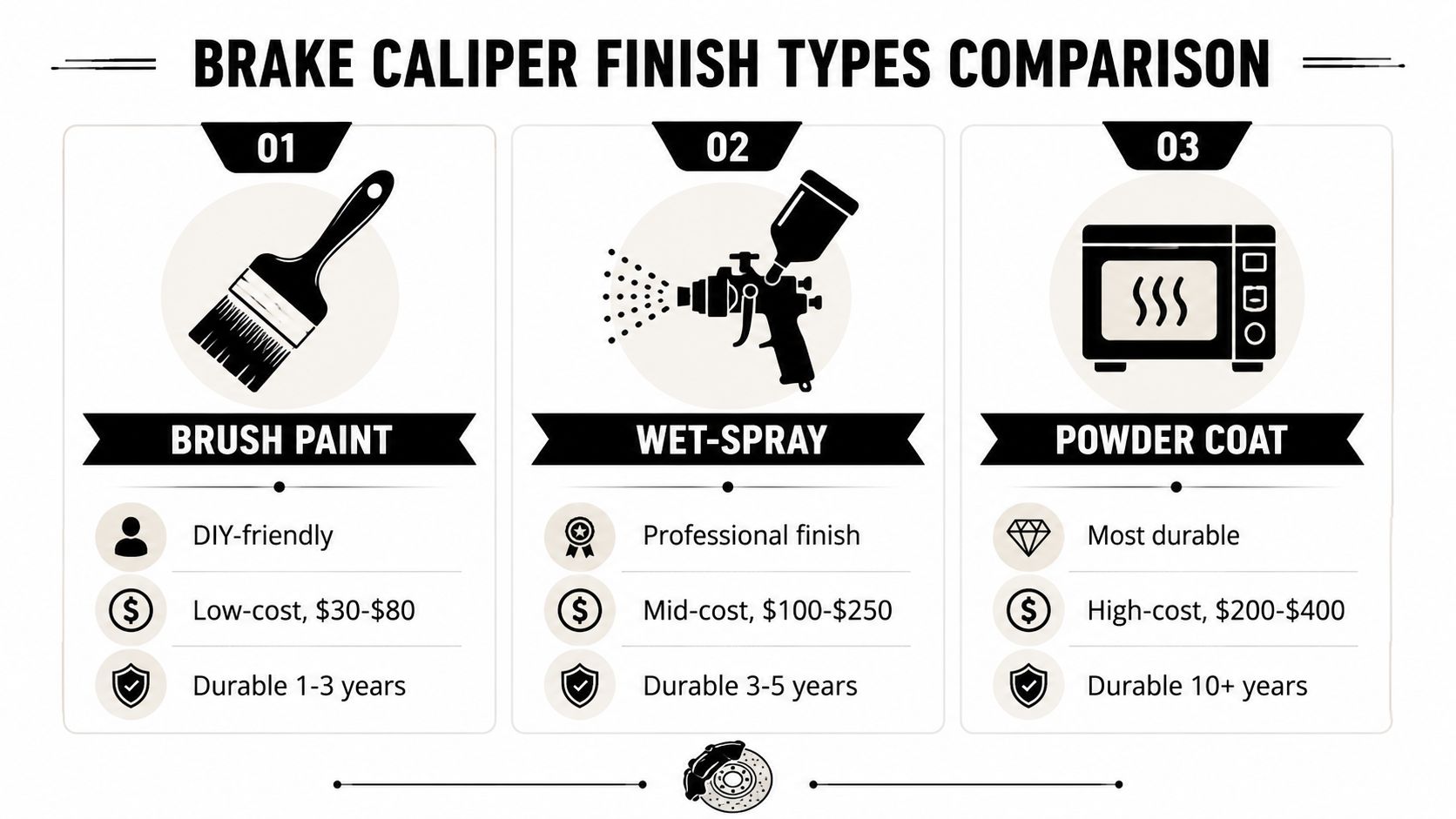
Three finish types dominate the job, and they are not the same thing. A brush-painted caliper is the budget route, a wet-sprayed caliper is the proper workshop finish for most cars, and powder coating is the most involved option, usually linked to off-car labour and heat curing. The right choice changes the landed cost once prep, decals, and any hub detailing are stripped out and priced properly.
The finish type changes the labour
Brush painting can work for a cheap tidy-up, but it shows every shortcut in prep. If the caliper is not cleaned and keyed properly, the coating will not hold well, and the finish will look uneven once the wheels are back on. Wet-spray gives a flatter surface, better gloss, and a cleaner colour match, which is why it is the sensible pick for most road cars and most wheel refurbishment jobs.
Powder coating sits at the top end because it is a bigger process, not just a different colour. As noted earlier, caliper powder coating in the US market is commonly priced around $175 to $200 per caliper or $700 to $800 for a set of four, and that reflects the extra labour and high-temperature curing involved (Paint Strategies). That extra processing is what pushes it above standard paint systems.
Powder coating usually means the calipers come off the car. Wet-spray can be more flexible, but the best results still come from proper access, proper cleaning, and proper masking.
What each method suits
Brush paint suits a quick cosmetic tidy-up, not a car where the calipers need to look right next to freshly refurbished wheels. Wet-spray suits owners who want the finish to hold its own against wheel refurbishment and hub detailing. Powder coat suits a deeper workshop job where the calipers are already coming apart and the owner wants a harder finish that justifies the extra labour.
What Is Actually Included in the Price You Are Quoted
Most confusion starts at the quote stage. A headline price can look tidy, then the job turns out to include cleaning, degreasing, masking, paint or powder, lacquer, decals, hub painting, and sometimes brake work if parts come off and need attention. That is where customers overpay, because they compare a bare number instead of the actual scope. A caliper job quoted for the UK market can range from £149 for front calipers only to £300 for front and rear calipers, but the landed cost changes fast once removal, brake bleeding, hub painting, or decals are added.
The quote should spell out the labour, not hide it
A proper workshop quote should say whether the calipers stay on the car or come off. It should also state whether the finish is brush, wet-spray, or powder coat, because those are different services with different labour and different results. If the price includes hub painting, that is a separate job, not dressing up the same line item. If decals are included, they should appear on the quote as their own item.
Cheap quotes often leave out the awkward bits. Removal and refit take time. Brake bleeding takes time if lines are opened. Decals cost money because they are not part of a basic paint job. The price you are shown can look low until the missing work is put back in.
Workshop manager's test: if you cannot tell what is included after reading the quote once, the quote is not detailed enough.
Scope is the other trap. Front calipers only is not a full set. On-car masking is not off-car preparation. A single-colour spray is not the same as a job that includes lacquer and logo decals. Owners who understand those differences stop paying for fluff and stop expecting proper workshop work at bargain-basement money.
Two Realistic Customer Scenarios Compared
A useful way to judge brake caliper painting cost is to look at two jobs side by side. One is a basic hatchback refresh with the calipers left on the car as much as possible. The other is a performance saloon where the calipers come off, the hubs are painted, and the owner wants decals and new pads fitted at the same visit. The first is cosmetic. The second is a full presentation job.
| Cost Element | Basic Wet-Spray On-Car | Full Off-Car Powder Coat |
|---|---|---|
| Caliper prep | Light cleaning and masking | Full disassembly, cleaning, and prep |
| Finish type | Wet-spray | Powder coat |
| Decals | Optional extra | Usually specified up front |
| Hub painting | Not always included | Often bundled in |
| Brake-related labour | Minimal | Greater due to removal and refit |
| Best fit | Everyday car, cosmetic refresh | Performance car, full wheel-and-brake visual reset |
Why the bills drift apart
The first job makes sense when the customer wants the car to look sharper without turning it into a mechanical event. The second makes sense when the owner is already spending on wheels, brakes, or a larger refurbishment and wants the whole area to look finished. The moment the calipers come off, labour grows, and so does the bill.
The same visual result can't be achieved at the same price if the scope is different. A basic job can be quick and decent. A full off-car job is more involved, more controlled, and more expensive because it asks the workshop to do more than paint.
How the Job Is Actually Done in a Workshop
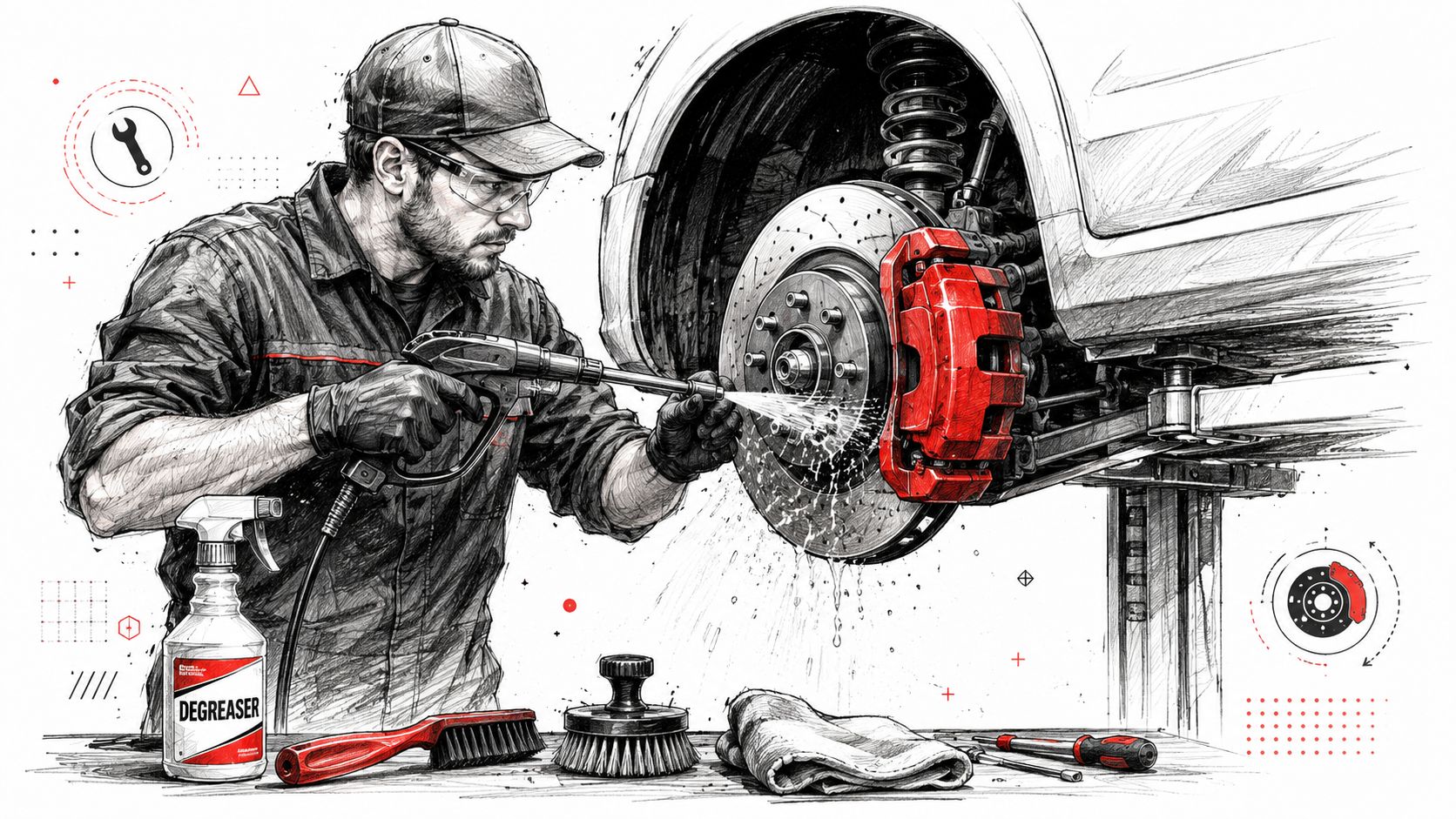
A decent caliper job starts with inspection, wheel removal, and a proper clean. The caliper has to be degreased, scuffed, masked, and readied for primer before colour goes anywhere near it. If the workshop is applying lacquer, that's part of the finish system, not a decorative extra.
Where the money goes
Prep eats time because brake dust, grease, and road grime don't disappear with a quick wipe. A good technician will also protect pistons, seals, brake lines, and disc faces so the finish stays on the caliper and nowhere else. That's the difference between a workshop job and a rushed cosmetic spray.
Powder coating is more invasive because the calipers usually need to come off and be rebuilt or refitted after curing. The process is more like restoration work than a trim colour change. Wet-spray is simpler, but it still needs discipline, especially around masking and surface prep.
The biggest shortcuts are obvious once you know what to look for. Skipping the scuff stage leaves poor adhesion. Painting over greasy calipers causes early failure. Rushing reassembly can damage the finish before the car even leaves the bay.
A properly equipped workshop also uses curing and controlled application to keep the finish consistent. That's the main reason the job costs what it costs. You're paying for sequence, control, and clean handling, not just for colour.
Mid-job, the equipment matters as much as the paint. The workshop video below gives a useful look at the handling side of that process.
Why the Cheapest Quote Often Costs More in the End
The cheapest quote usually wins on first glance and loses after a season of use. Low-priced work often skips proper degreasing, uses minimal masking, and relies on one thin coat with no lacquer. That's where the finish starts to fail, usually at the edges first, then more obviously once road dirt and brake heat do their work.
Failure is usually built in, not random
If the calipers stay on the car and the preparation is weak, overspray can land where it shouldn't. That creates mess on discs and neighbouring components, and cleaning it up takes time the customer didn't budget for. If the paint isn't high-temperature capable, the colour can degrade under normal braking conditions, which is a poor trade for a low initial quote.
The other issue is longevity. Cheap jobs tend to look fine in the car park and tired later on because the surface wasn't prepared for adhesion. That's not bad luck. That's the consequence of stripped-back labour.
Cheap caliper painting is only cheap if you don't count the redo.
A proper quote should reflect durability, not just the day-one appearance. If the workshop is doing the job properly, it has to spend time on prep, application, and finishing. That time is what prevents a return visit and turns the spend into value.
Pairing Caliper Painting with a Wheel Refurbishment
Caliper painting makes the most sense when it's part of a wheel refresh, not a standalone vanity job. Freshly refurbished OEM alloys can make a tired caliper look even worse, while a clean caliper colour can make refurbished wheels look more intentional and finished. The visual connection is obvious the moment the car rolls out of the bay.
One visit, cleaner result
If the wheels are already coming off for refurbishment, that's the natural time to handle the calipers too. You're already paying for access, so it makes sense to use that access once rather than twice. That's the practical logic behind combined cosmetic work, and it's why in-house wheel and caliper capability is useful for owners who want the car to look coherent rather than patched together.
The Alloy Hub Ltd. is one UK option that handles OEM alloy wheels, wheel refurbishment, tyres, and brake caliper painting in the same broader service flow. That matters because the caliper colour can be chosen around the wheel finish, rather than as an afterthought once the wheels are already back on the car.
If the wheel finish changes, the caliper colour should be chosen after that decision, not before it.
Owners save themselves from mismatched choices with a smart combination of wheel refurbishment and caliper painting, which usually gives more visual impact than spending the same money on isolated cosmetic tweaks.
Your Pre-Booking Checklist for a Quality Caliper Respray
Before you book, ask the workshop what finish they're quoting, because brush, wet-spray, and powder coat are different jobs. Ask whether the calipers come off the car, whether the price includes hub painting and decals, and whether brake bleeding or other brake work is part of the quote. If the answer sounds vague, keep asking until it's clear.
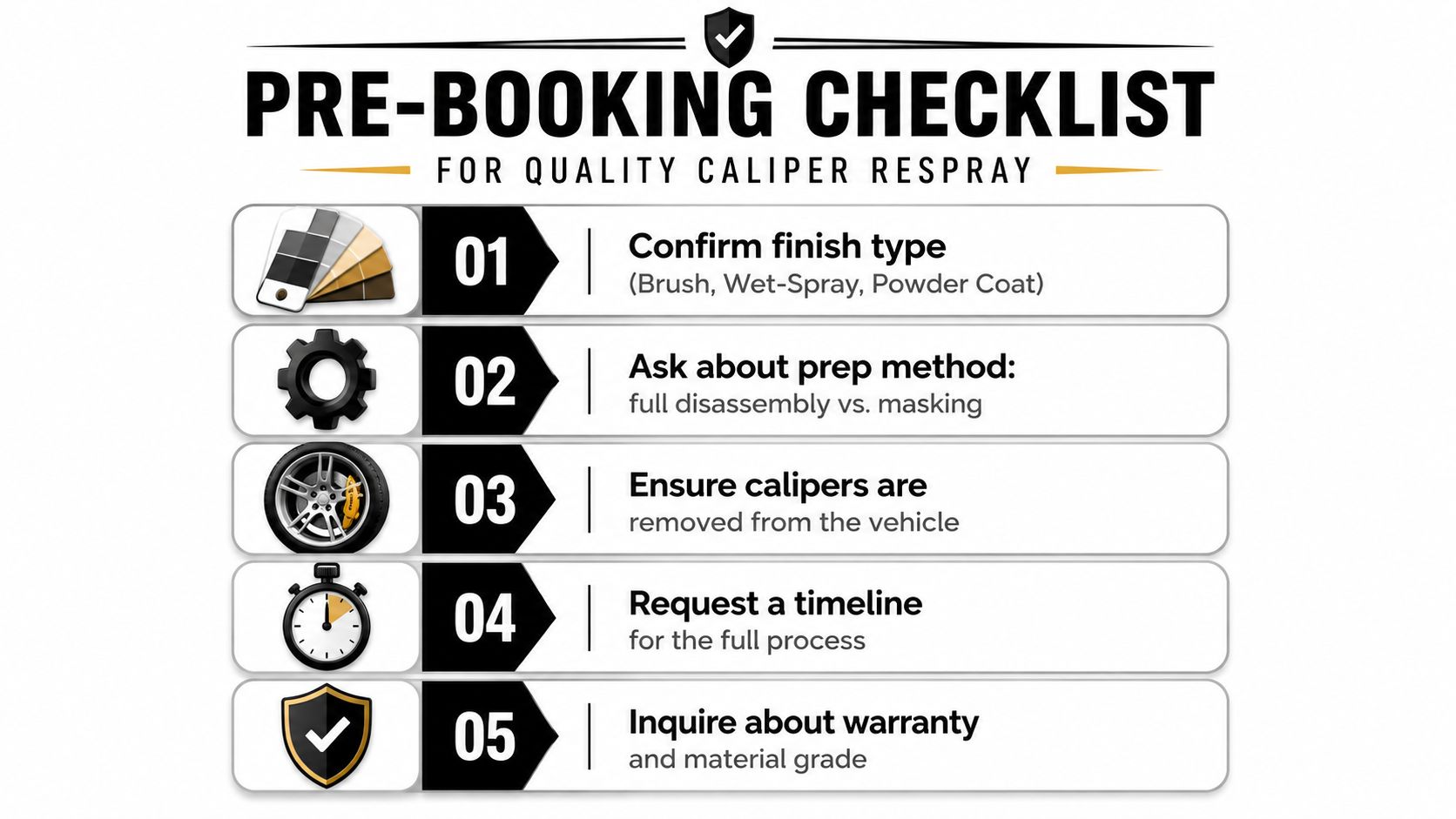
Questions worth asking before you hand over the car
- Confirm the finish type: Make sure the quote says brush paint, wet-spray, or powder coat, not just “caliper paint”.
- Ask about prep method: You want to know if the workshop is cleaning, scuffing, and masking properly or just applying colour quickly.
- Check removal and refit: If the calipers stay on the car, the scope is usually different from an off-car job.
- Clarify extras: Decals, hub painting, and brake-related labour should be listed, not assumed.
- Ask about timing and warranty: A workshop that stands behind the work should be able to explain turnaround and aftercare clearly.
The safest rule is simple. Don't buy a colour, buy a process. If the process is clear, the finish usually is too.
If you're weighing up caliper painting alongside wheel refurbishment, The Alloy Hub Ltd. handles OEM alloy wheels, refurbishment, tyres, and caliper painting in one place. Visit The Alloy Hub Ltd. to see how a coordinated wheel and brake refresh can be planned properly, without treating calipers as an afterthought.