Cracked alloy wheels are only repairable when the crack sits in the inner barrel or rim lip. If it runs through a spoke, the hub bore or the bolt seats, the wheel should be replaced with a correct OEM wheel. That's the safe rule, and it matters more than cost, because a cracked wheel is a structural failure, not a cosmetic problem.
You're usually dealing with this after a pothole hit or a hard kerb strike, and the first question is never “how cheap can this be fixed”. The key question is where the crack is, because that decides whether a specialist can weld it or whether the wheel has crossed the line into replacement territory.
Table of Contents
- Can a Cracked Alloy Wheel Be Repaired
- Why Cracked Wheels Are a Safety Issue Not a Cosmetic One
- Repairable Crack Zones Versus Replacement Zones
- How Specialists Repair a Repairable Crack
- What a Cracked Wheel Repair Costs in the UK
- Why OEM Replacement Is Sometimes the Smarter Choice
- Why DIY Repair Is Not the Answer for a Cracked Wheel
- FAQs on Repairing a Cracked Alloy Wheel
Can a Cracked Alloy Wheel Be Repaired
Yes, but only in the right place. A cracked alloy wheel can be repaired when the crack is short, single, non branching and confined to a low stress area like the inner barrel or rim lip, but cracks in the spoke, hub bore or bolt seats are replacement jobs, not repair jobs, because those areas carry load and clamp force TireFitLab repair guidance.
The decision starts with location
That's the part a lot of drivers get wrong. They hear “alloy wheel crack” and jump straight to “can it be welded”, but the correct question is whether the crack sits in a zone where welding can restore strength without compromising the casting.
A wheel is an engineered component, not a decorative disc. Once the crack sits in a structural path, the wheel has already failed as a load bearing part, and the sensible call is replacement with an OEM wheel that matches the car properly. UK repair guidance makes that same distinction, saying cracks in the spoke, hub bore, bolt seats, bead seat or other load bearing zones should not be repaired, while only short cracks in lower stress areas may be considered for professional welding and inspection wheel repair safety limits.
Practical rule: if the crack is anywhere a wheel tightens to the car or carries cornering load, replace it. If it's in the barrel or lip and a specialist says it's short and clean, then repair may be on the table.
That's the starting point every time. Cost, finish and turnaround come later. First comes the crack location, then the verdict.
Why Cracked Wheels Are a Safety Issue Not a Cosmetic One
A cracked wheel behaves very differently from a scuffed one. A scuff changes how the wheel looks, but a crack changes how the wheel holds air and handles the forces from cornering, braking and pothole impact. That's why cracked wheel repair belongs in the safety category, not the cosmetic one.
In the UK, that distinction matters because road damage is the norm, not the exception. One UK guide cites ŠKODA research suggesting there may be over 13 million kerb damaged alloy wheels on UK roads, with the estimated cost of fixing them all at £890 million. The same source says kerb strikes account for over half of wheel damage incidents, while potholes are described as the number one cause of serious damage, responsible for around 60% of alloy wheel cracks wheel repair safety limits.
Why the wheel's job changes the answer
An alloy wheel carries the vehicle's weight, clamps the tyre and takes repeated shock loads every time you brake, turn or hit a defect in the road. If the crack sits in the wrong place, the wheel can lose pressure or separate under load without much warning. That's why a specialist doesn't look at the colour or the brand first, they look at the crack path.
A cracked wheel also sits in the same conversation as other structural damage. If the wheel is buckled as well as cracked, the risk profile changes further. The right comparison is not with a kerbed finish, it's with a load bearing part that has already been compromised. For a broader look at that kind of damage, see the guide to buckled alloy wheel signs.
The honest takeaway is simple. A crack isn't just damage. It's a question about whether the wheel can still do its job safely.
Repairable Crack Zones Versus Replacement Zones
Treat the wheel like a map, not a yes-or-no question. The crack's location tells you what to do. A short crack in the inner barrel or rim lip can sometimes be repaired if the rest of the wheel is sound. Cracks in the spokes, hub bore, bolt seats or bead seat put the wheel into replacement territory because those areas carry load, clamp force or tyre seal.
| Crack Location Versus Repair or Replacement Decision | Typical Verdict | Reason |
|---|---|---|
| Inner barrel | Repair may be possible | Low stress area, often considered for professional TIG welding and inspection |
| Rim lip | Repair may be possible | Can be a lower stress zone if the crack is short and non branching |
| Bead seat | Replace | Critical for tyre sealing and wheel integrity |
| Spoke | Replace | Structural load path, crack can spread under cornering and braking loads |
| Hub bore | Replace | Central mounting zone, structural failure risk |
| Bolt seats | Replace | Clamp force area, damage here affects how the wheel is held to the hub |
Read the table against the wheel itself. A repairable zone usually shows a single crack line, clean edges and no sign of branching. A replacement zone often shows a crack where the wheel does the structural work, or damage that has started to open up under pressure. If the crack has travelled through a structural section, stop there and plan on replacement.
The quickest way to check is visual. Look for a crack that follows the lip or lower barrel and stays away from the spokes and mounting faces. Then inspect the opposite side of the wheel, because a hard impact can mark both the visible face and the hidden surface. If the crack runs into the spoke, hub bore or bolt seats, do not treat that wheel as a repair candidate. For a simple reference on repair zones and inspection priorities, use the Alloy Hub repair guide.
A wheel with a crack in a low-stress area can still be a serious job if the line is long, branching or dirty with corrosion. A wheel with a crack in a load-bearing zone is done. The useful question is not whether the wheel still looks presentable, it is whether the crack sits in a section the wheel depends on to hold the car up and stay clamped to the hub.
How Specialists Repair a Repairable Crack
A proper crack repair is controlled metalwork, not a quick patch. The accepted process starts with full tyre removal, because the wheel has to be stripped before anyone can inspect the crack, clean the metal and prepare the weld area properly. One professional guide describes the repair as TIG welding after cleaning, V groove preparation and stop drilling the crack tip to slow further propagation The Wheel Specialist.
What the job actually involves
The damaged area has to be stripped of coating, contamination removed and the crack opened up for full penetration. One expert guide says the coating should be removed at least two inches around the crack and the repair should use 4043 or 5356 aluminium filler rod, with 150 to 200 amps on AC TIG as a typical starting range for wheel thicknesses of 5 to 8 mm Jimbo's Slice Workshop.
That detail matters because the wheel isn't forgiving. Poor penetration, dirty metal or excess heat can weaken the casting and let the crack reopen under braking, cornering or another pothole hit. This is specialist work, and it needs someone who understands aluminium, heat input and finish work.
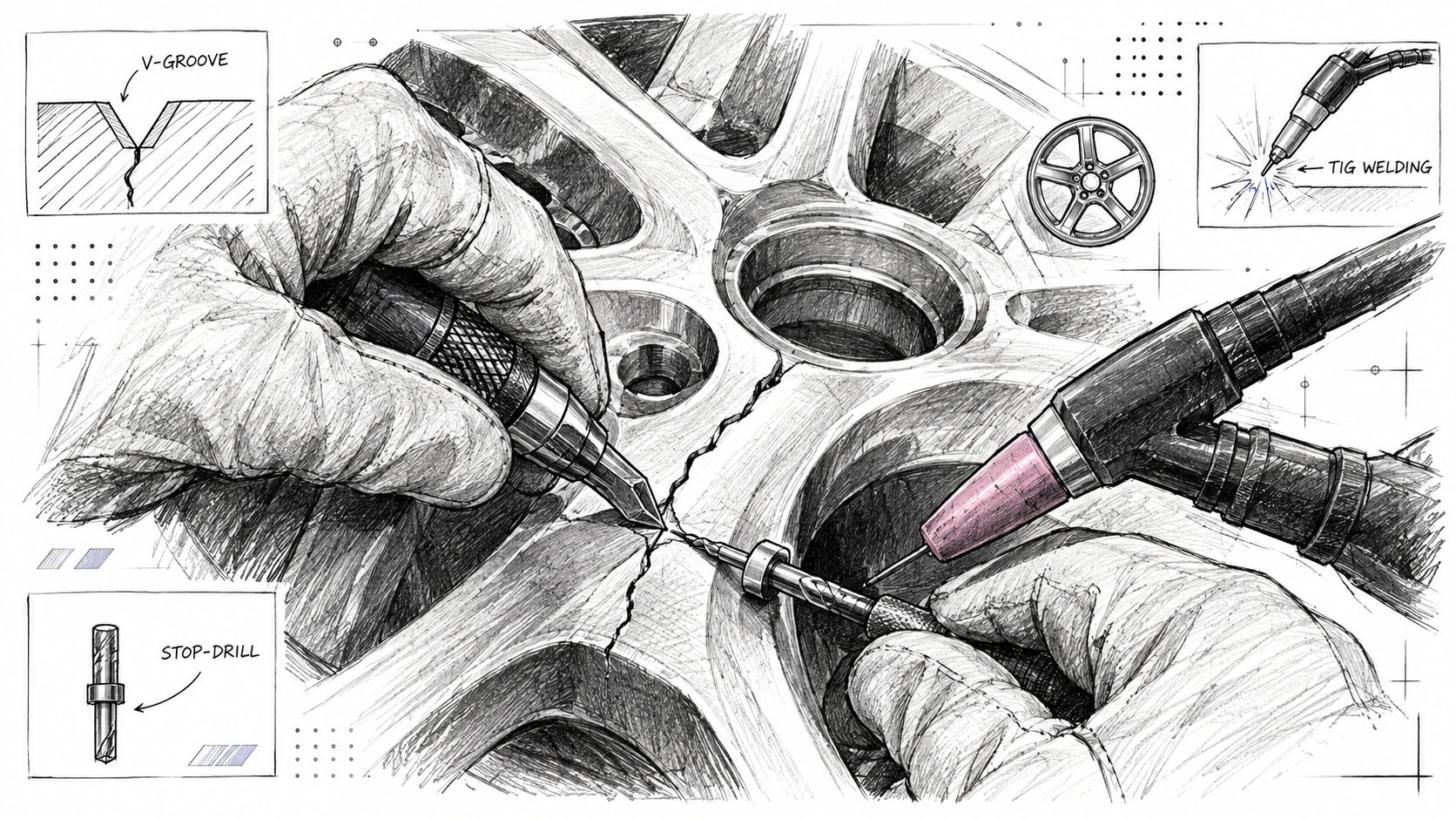
The repair then gets ground back, checked and refinished so the tyre seats properly and the wheel can be put back into service. That's the process a real repair follows, not a roadside fix or a dab of filler.
Later in the job, the inspection stage matters just as much as the weld. A specialist decides whether the crack behaved like a repairable flaw or a deeper structural failure.
Practical rule: if the workshop can't explain the prep, the weld method and the inspection, walk away.
For local wheel work, The Alloy Hub Ltd. provides an in house refurbishment service from Staffordshire, including crack assessment and wheel refinishing at its Leek facility. The relevant service page is alloy wheel repair in Leek and wheel refurbishments.
What a Cracked Wheel Repair Costs in the UK
UK pricing shows why crack repair is a specialist decision, not a routine refurb. One UK guide says cracks are typically not repairable and lists replacement costs at £100 to £500+ for cracked or badly buckled alloy wheels, while light scuffs are only £50 to £80 per wheel Carowl refurbishment guide. Another UK source says hairline crack repairs can start from £50, deeper 1 to 2 inch cracks from £80, and complex multi pass structural repairs from £120 Carowl refurbishment guide.
Why the bill changes so much
The spread makes sense once you separate cosmetic work from structural work. A minor refurb is one thing. A crack repair needs inspection, prep, welding, cleanup and often refinishing, so the labour adds up fast. A separate UK guide places cracked alloy repair at about £70 to £85 per crack and notes that minor kerb damage typically costs £50 to £90 per wheel, again showing the divide between surface work and structural repair Carowl refurbishment guide.
Replacement is often the cleaner financial decision once the crack is in the wrong place or the wheel needs a complex weld. That's especially true on premium OEM wheels, where the supply price is higher but you're also buying back the original specification and load path.
For repair budgeting and refurb comparisons, The Alloy Hub's wheel refurbishment cost guide is the right place to compare the usual options.
The point is simple. A crack repair can be cheaper than replacement, but not always once you factor in the right process and the risk of doing it twice.
Why OEM Replacement Is Sometimes the Smarter Choice
Replacement isn't a defeat, it's the right answer when the wheel has failed structurally. A correct OEM wheel restores the original load rating, PCD, offset and centre bore without guesswork, which is exactly what you want after a crack in a structural zone. That's why a replacement wheel can be the cleaner and safer outcome, especially when the crack is in a spoke, hub bore or bolt seat.
The case for replacing instead of welding
A welded crack in a critical zone can re open under load. Even if the repair looks neat, it's harder to defend later if a buyer, insurer or inspection report asks how the wheel was restored. A documented OEM replacement is much easier to stand behind because the casting is intact and the wheel is back to manufacturer specification.
That matters for leases, warranties and dealer stock too. If you need a clear reference on warranty expectations in the used car trade, the guide to used car warranties for traders is useful context when you're deciding whether a structural wheel repair is worth the risk on a sale vehicle.
Practical rule: if the crack sits in the wheel's main load path, replace the wheel. Don't spend money trying to rescue a structural failure.
The UK road environment makes that call even more sensible. Pothole damage remains a live problem, so a cracked wheel has already proven it's been pushed hard enough to fail once. In that situation, a genuine OEM replacement is the safer long term answer, and it fits the business view that replica wheels are not a sensible shortcut when fitment and structural integrity matter.
For drivers, that means the choice is not repair versus spending. It's repair versus a wheel that still deserves to be on the car.
Why DIY Repair Is Not the Answer for a Cracked Wheel
Don't try to fix a cracked alloy wheel at home. The equipment gap alone should stop you, because proper crack repair depends on clean metal, controlled heat and an experienced TIG welder who knows how aluminium behaves under stress. A home patch, a local general welder or a repair kit doesn't control any of that.
Why the risk is so high
The core issue is contamination and heat. A wheel is a load bearing casting, so dirt, trapped coating or poor prep can spoil the weld. Too much heat can warp the wheel or weaken the metal around the crack, and that turns a repairable fault into a bigger failure.
One UK repair guide says cracked alloy wheel repair is “typically performed using TIG welding” and is only safe for small cracks on the inner lip or barrel, while home repair is not recommended because the process needs specialist tools, materials and skill Alloy Wheel Repair Services. That's the line to respect.
If the wheel is in a non critical area and you're happy to use a specialist, repair is worth discussing. If the crack is structural, the answer is replacement, not a DIY experiment. A wheel that fails at speed doesn't just risk the car, it risks everyone in it.
The only sensible filter is this. Low stress crack, specialist repair. Structural crack, OEM replacement.
FAQs on Repairing a Cracked Alloy Wheel
Can a cracked alloy wheel be repaired without removing the tyre?
No. A proper repair needs the tyre off so the specialist can inspect the crack, clean the metal and prep the weld area properly. If someone says they can fix it with the tyre still on, they're not doing a proper structural repair.
How long does a cracked wheel repair last?
A well judged repair on a low stress area can hold up, but only if the crack was repairable in the first place and the welding was done correctly. If the crack sits in a structural zone, no repair should be relied on. That's why the first decision is more important than the weld.
Will an insurer prefer repair or replacement for a pothole damaged wheel?
Insurers usually want the safer, defensible outcome, not the cheapest patch. If the crack is structural, replacement is easier to justify. If it's a low stress lip or barrel crack, a specialist repair may be acceptable, but the wheel's condition and crack location still decide the result. For extra finish protection after replacement or repair, Titan's ceramic wheel care guidance is a useful read.
The Alloy Hub Ltd supplies genuine OEM alloy wheels and carries out wheel refurbishment from its Staffordshire facility, including crack assessment where a repair is safe. If your wheel has a crack in a structural zone, or you want a correct OEM replacement matched to the car, visit The Alloy Hub Ltd. and get the right wheel sorted.