You've got a wheel that looks right at a glance, but the replacement you're being offered doesn't quite match. The colour is close, the spokes are similar, and the seller calls it anthracite, yet the finish looks warmer, flatter, or darker than the wheel already on the car. That's the point where most buyers go wrong, because anthracite is not one single colour, it's a finish family, and the exact shade depends on the OEM specification, the part number, and how the wheel was refinished.
Table of Contents
- What Anthracite Actually Means for Alloy Wheels
- The Spectrum of Anthracite Shades and Finishes
- Identifying Your Exact OEM Anthracite Specification
- Refurbishment Methods for Anthracite Alloy Wheels
- Matching Anthracite Wheels to Your Vehicle
- Why Genuine OEM Wheels Matter for Anthracite Finishes
- Choosing Between New OEM Wheels and Refurbishment
What Anthracite Actually Means for Alloy Wheels
A customer usually notices the problem after a kerb scrape or a tyre change. The car still looks fine from ten feet away, but one wheel has been painted, one has faded, and the replacement on offer is labelled anthracite without any useful detail. In that moment, anthracite alloy wheel stops being a style phrase and becomes a specification question.
Dark grey, but not just dark grey
Anthracite sits in the dark grey to charcoal part of the wheel-finish spectrum. It gives the car a more restrained look than silver, but it doesn't disappear the way gloss black can on some body colours. That balance is why it shows up so often on refurbished OEM wheels, especially when the owner wants the car to keep a factory-plus appearance rather than look obviously modified.
The UK context matters here. Alloy wheels moved from sporadic early use in the 1920s to broader public adoption in the 1980s, and by 2016 they were almost universally included on modern cars according to independent history sources history of alloy wheel adoption. That long shift from niche to mainstream explains why anthracite feels normal now. It fits the modern UK taste for darker, premium-looking wheels without shouting for attention.
Practical rule: if a seller can't tell you whether the wheel is painted, powder coated, brushed, or diamond-cut, treat “anthracite” as a starting point, not an answer.
Why the finish matters more than the label
The label alone doesn't tell you whether the wheel will match your existing set. Two wheels can both be called anthracite and still look different in the light, especially if one has a metallic flake and the other has a flatter coating. That's why buyers chasing a factory look need more than a colour name, they need the OE part number, the model-year fitment, and the finish method.
Anthracite also works well because it echoes the premium, understated direction that many OEMs have used on alloy wheels for years. It's a finish chosen for refurbished wheels, dealer accessory wheels, and higher-spec factory trims because it reads as tidy, mature, and intentionally specified. If the rest of the car is already balanced and clean, anthracite tends to look deliberate rather than decorative.
For a related visual comparison, it helps to look at headlight cleaning ideas as a parallel. Clean, properly finished wheels and clear lamp lenses usually pull the whole front end together in the same way.
The Spectrum of Anthracite Shades and Finishes
The biggest mistake is assuming all anthracite wheels are interchangeable. They aren't. Manufacturer-specific shades vary, and even within one brand the same word can cover a warmer metallic look, a cooler grey, or a more muted satin surface. That's why buyers often approve the colour in one setting and reject it in another.
Finish type changes the visual result
A gloss anthracite wheel reflects more light and usually appears deeper and more polished. Satin anthracite sits in the middle, with less glare and a more modern OEM feel. Matte anthracite absorbs more light, so it can look almost gunmetal in bright conditions and nearly black in shade.
Brushed and diamond-cut anthracite is a different proposition again. The visible face is machined so bare alloy shows through, while the inner barrel and spoke pockets stay dark. Škoda's UK and European accessory listings show exactly this kind of OEM approach, for example an anthracite-brushed 19-inch wheel for the Octavia IV at 7.5J x 19 ET48, and a metallic anthracite 20-inch wheel for the Enyaq and Elroq at 8J x 20 ET45 Škoda alloy wheel listing. The point isn't the brand, it's the method, anthracite is paired with precise geometry, not used as a loose decorative option.
Lighting changes the shade you think you're seeing
A wheel that looks almost black indoors can read as medium grey on the road. Metallic flakes catch overhead showroom light, while satin finishes flatten out under cloudy skies. That's why a customer comparing a spare wheel in the workshop to a car parked outside often thinks the colours don't match, even when the coating is close.
The internal reference I'd send buyers to is the Alloy Hub colour trends guide for 2026, because it frames anthracite the way the market uses it, as one shade family among several, not as a single paint chip. That distinction matters when the wheel is being selected for an OEM-style refresh rather than a full restyle.
A good anthracite match is judged at the car, not under a bench light.
For practical work, I tell customers to describe three things, the tone, the sheen, and whether the face is plain painted or brushed. If you can't say those three things, you're not ready to order a replacement yet.
Identifying Your Exact OEM Anthracite Specification
The cleanest-looking anthracite wheel is useless if it won't clear the brakes or sit correctly in the arch. Fitment is where the work starts, and it's where a lot of searches go off the rails because buyers focus on finish before they've checked the dimensions. The right anthracite wheel must match the vehicle, not just the photograph.
Start with the numbers on the wheel and the car
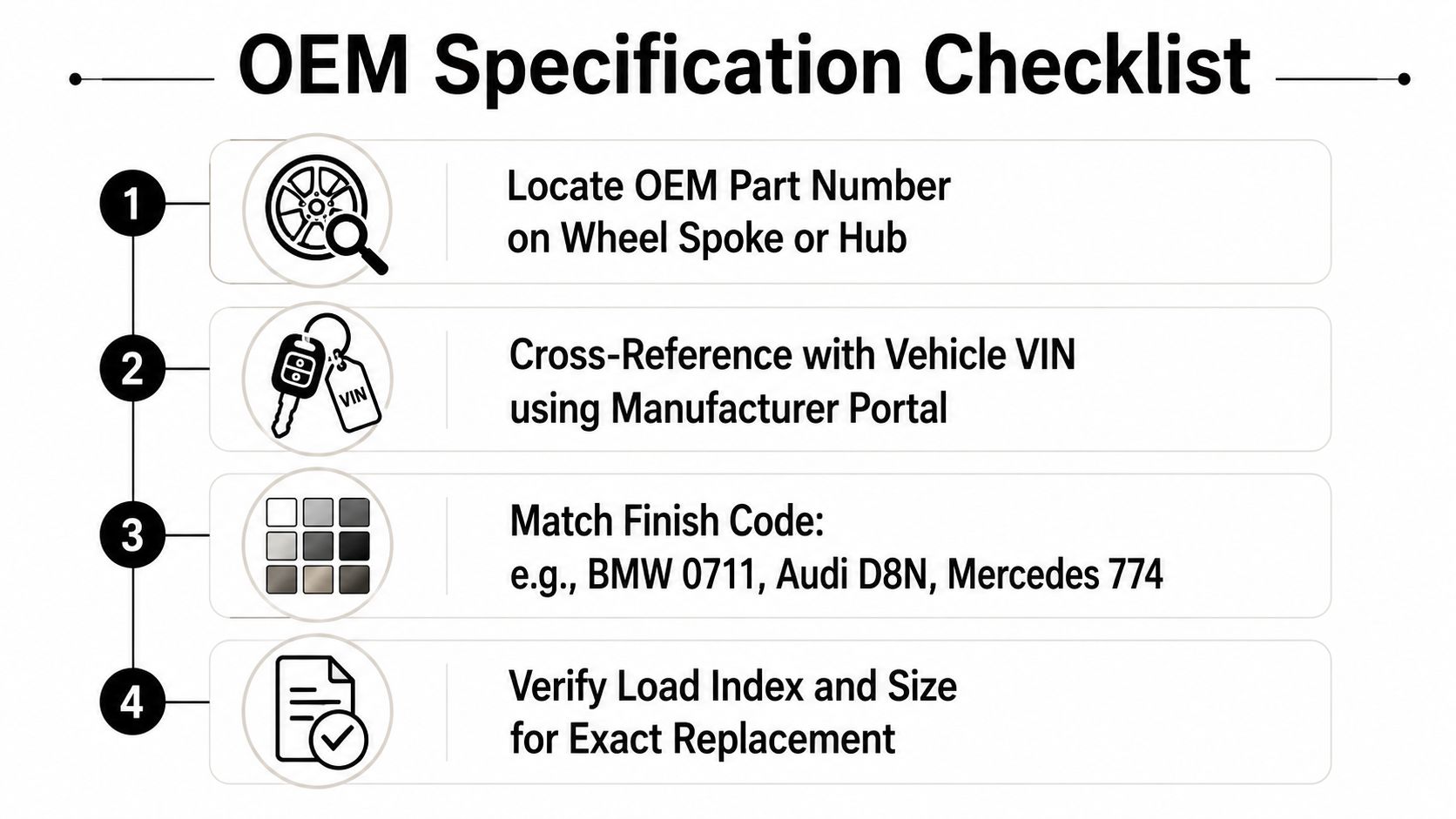
The first place to look is the existing wheel itself. OEM part numbers are often cast or stamped on the back of the spoke or around the hub area, and those numbers tell you far more than a sales listing ever will. Once you have that, cross-check the vehicle registration, model year, and any factory accessory catalogue for the exact wheel option.
You then need the core dimensions, diameter, width, offset (ET), and PCD. Width affects tyre fitment and shoulder shape. Offset affects how far the wheel sits inboard or outboard, which changes caliper clearance and rubbing risk. PCD has to match the hub pattern exactly, or the wheel won't mount.
Practical rule: if width or offset is wrong, the wheel may still bolt on, but that doesn't make it correct.
Why anthracite wheels often sit in OEM accessory catalogues
Anthracite is frequently used on larger OEM light-alloy wheels, especially in the 19-inch to 20-inch range, because the darker finish suits the visual mass of bigger diameters. That doesn't make smaller anthracite wheels rare, it just means the factory often uses the finish to support a premium trim position. The colour and the geometry are selected together.
For a concrete pattern, look at manufacturer accessory listings rather than general marketplaces. Those listings show how the wheel is presented as a complete specification, not just a colour. If you're trying to decode your own wheel, the internal guide on how to identify your alloy wheels is the kind of reference that keeps the conversation grounded in the right measurements.
A quick workshop check that saves money
Before ordering, I'd check these points in order.
- Part number first: confirm the OE number from the wheel or manufacturer catalogue.
- Vehicle match second: verify model, trim, and year, because small revisions change fitment.
- Geometry third: confirm width, diameter, ET, and PCD together, not one by one.
- Finish last: decide whether you need painted anthracite, brushed anthracite, or a refurbish to factory appearance.
The exact wheel size matters because the wrong offset can create rubbing, and the wrong width can force a tyre choice that compromises the look or the handling. If the wheel is a genuine OEM fit, the specification should read like a vehicle component, not a style descriptor.
Refurbishment Methods for Anthracite Alloy Wheels
If the wheel is straight and structurally sound, refurbishment is often the smarter route than replacement. Anthracite is a forgiving colour for refurbishment because it hides light use well, but the method still makes a huge difference to the final result. A rushed spray job can look acceptable on day one and wrong by week two.
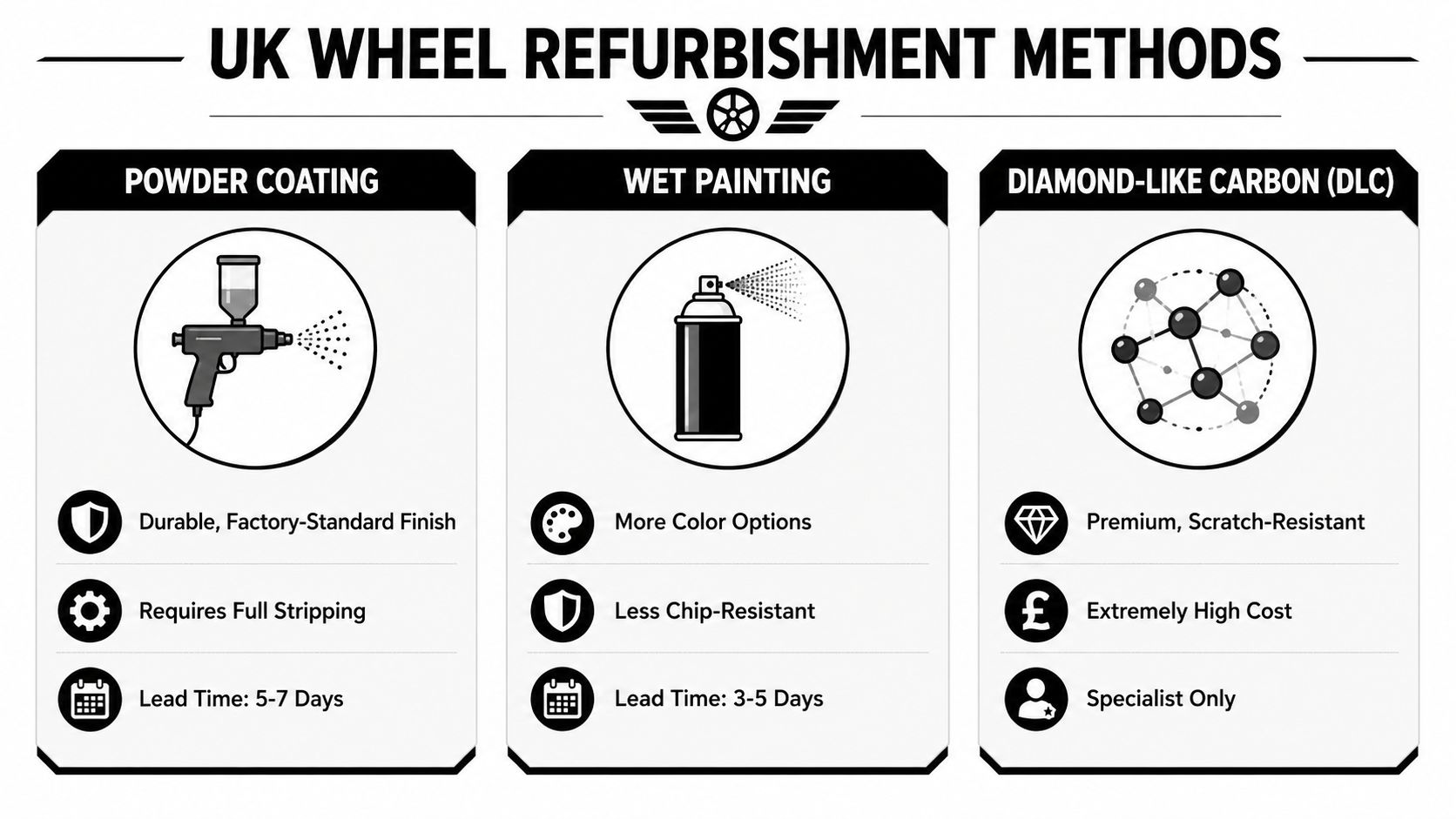
Powder coating, wet paint, and diamond cutting
Powder coating is usually the strongest option for an anthracite finish when the goal is a factory-style result. The wheel is stripped, prepared, coated electrostatically, then cured so the surface is tough and consistent. In-house refurbishment services such as The Alloy Hub Ltd. use this route alongside colour changes, diamond cutting, and straightening where appropriate, which is the kind of full-process control that matters when you want the finish to match rather than cover damage.
Wet painting gives more flexibility on shade and is useful when a very specific anthracite tone needs to be mixed. It can look excellent, but it's more sensitive to prep quality and usually less chip-resistant than powder coating. Diamond cutting belongs in a separate category, because it creates the bright machined contrast on the face rather than a uniform anthracite surface.
What the refurbishment process should include
A proper job should begin with inspection, not sanding. The wheel needs to be checked for bends, cracks, corrosion, and any damage that would make a cosmetic finish unsafe or short-lived. If the wheel needs straightening or repair before coating, that work has to happen first.
Then comes stripping, cleaning, surface preparation, coating or painting, curing, and final quality check. A good shop will also discuss whether the wheel is suitable for repair at all, because some damage is beyond sensible refurbishment and should be replaced. For buyers who want a deeper comparison of finishes, the mirror shine wheel care guide is useful because it shows how the final gloss level changes the whole look.
If the repair shop won't explain the prep stages, they're asking you to trust a finish they haven't earned yet.
When refurbishment is the wrong answer
A wheel that's cracked, heavily buckled, or too corroded at critical points shouldn't be treated as a cosmetic project. At that stage, replacement is the safer move. Anthracite only matters after the wheel has passed the structural check.
Matching Anthracite Wheels to Your Vehicle
Anthracite works because it's restrained. On the right car, it sharpens the design without overpowering it, and that makes it easier to pair with a wide range of body colours. On the wrong car, or with the wrong sheen, it can look flat and unfinished.
Colour pairing that usually works
White and silver bodywork are the easiest matches, because anthracite creates enough contrast to define the wheel without turning the side profile into a black mass. On darker cars, it gives a quieter, more technical look than bright silver or chrome-style finishes. That's one reason it shows up so often on premium saloons and SUVs.
Performance hatchbacks benefit too, especially when the wheel design has enough spoke detail to catch light. Electric vehicles also suit anthracite well because the finish often complements the cleaner surfacing and the more modern, understated visual language of the car. The finish works across body types because it doesn't fight the design, it sits inside it.
Small styling choices change the outcome
Brake caliper colour can make anthracite feel either sharper or more anonymous. A clean caliper finish gives the wheel more definition, especially on open-spoke designs. If the calipers are rusty, the whole setup looks tired no matter how good the wheel coating is.
The wheel design also matters. Thin spokes tend to make anthracite look more technical. Chunkier designs make it read darker and heavier. That's not a flaw, just a different effect, and it's why a wheel that looks excellent on a BMW saloon may feel too heavy on a smaller hatchback.
Practical rule: anthracite should look like an intentional OEM decision, not like a compromise between silver and black.
How to judge the final look
Stand back and check three things, the wheel face, the arch gap, and the brake hardware behind it. If the wheel, the tyre sidewall, and the body colour all sit at the same visual weight, the car can start to look monotone. If there's enough contrast between the finish and the paint, anthracite looks tidy and expensive without needing much else.
Why Genuine OEM Wheels Matter for Anthracite Finishes
Anthracite is often sold as a style choice, but the wheel underneath is a safety component first. Genuine OEM wheels are built to the manufacturer's specification for fitment, load, and geometry, which is why they're the cleaner choice when the goal is a factory-style finish that still behaves like a factory wheel. Replica wheels may look close in photos, yet still miss the details that matter on the road.
Fitment and safety come before appearance
A genuine OEM wheel is designed around the vehicle's braking package, hub, suspension geometry, and approved dimensions. That means the offset, width, and load-related design intent are built into the part rather than guessed later. With anthracite, that matters because many buyers only notice the visual side and forget that the finish is sitting on a structural part.
Replica or copy wheels can create questions around insurance, MOT inspections, and long-term confidence if they don't line up with the vehicle's specification. A wheel that looks correct but isn't built to the same standard is a false economy. Anthracite doesn't hide that problem, it just makes it easier to overlook at first glance.
If you want a deeper manufacturer-led explanation, the internal article on the benefit of OEM alloy wheels is the right companion reading.
Resale value and buyer confidence
Used-car buyers notice wheels quickly. Genuine OEM anthracite wheels tend to feel more credible because they match what the car should have had from the factory or accessory range. That doesn't mean every buyer will ask for the part number, but knowledgeable buyers do look for signs that the car hasn't been pieced together from generic replacements.
OEM also gives you a stronger starting point for refurbishment later on. If the wheel has the right shape, the right mounting geometry, and the right provenance, refinishing it back to anthracite is straightforward. With a replica wheel, the finish may look close while the underlying specification stays uncertain.
Choosing Between New OEM Wheels and Refurbishment
The right answer depends on what's wrong with the current wheel and what you want the car to look like at the end. If you're choosing purely on cost, you'll miss the more important question, which is whether you're solving a cosmetic issue or a fitment issue. Those are not the same job.
Buy new when the wheel itself is the problem
A new OEM anthracite wheel makes sense when the old one is damaged beyond repair, when you're changing to a different factory style, or when you need a specific original option that wasn't fitted to the car in the first place. It also makes sense if you're replacing a single wheel and the existing one can't be matched cleanly by refurbishing the set. In those cases, the new part removes doubt.
Refurbish when the structure is sound
Refurbishment is the better route for scuffs, fading, light corrosion, and cosmetic colour changes. If you want to keep the original wheel design but freshen it up in anthracite, powder coating or a controlled paint process usually gives the most coherent result. It's also the better option when you're trying to preserve the OEM look rather than alter it.
Think about trade-in and logistics
If you're moving to a different style altogether, trade-in can reduce the hassle of disposing of the old set. That matters when you don't want the vehicle off the road for long or you need the work done with minimal disruption. Some owners also prefer workshop fitting, while others want a supply-only route and arrange fitting separately.
The Alloy Hub Ltd. works across genuine OEM wheel supply, in-house refurbishment, fitting, tyre supply, and trade-in, so the practical route doesn't have to be split between several vendors. If you're ready to sort an anthracite wheel properly, visit The Alloy Hub Ltd. and check the OEM options, refurbishment services, and fitment support before you order.