Wheel powder coating cost in the UK usually starts at £60 to £120 per wheel for a standard alloy, or £240 to £480 for a set of four before extras. Once you add stripping, corrosion repair, masking, or a more complex finish, the quote climbs quickly because you're paying for labour, prep, and oven time, not just colour.
Table of Contents
- What Wheel Powder Coating Actually Costs in the UK
- How the Powder Coating Process Works on an Alloy Wheel
- What Drives the Price Up or Down
- Powder Coating Versus Paint, Diamond Cut, and OEM Replacement
- When Refurbishment Stops Making Financial Sense
- How Long a Powder Coated Finish Actually Lasts
- Choosing a UK Refurbishment Shop Without Getting Burned
- FAQ
What Wheel Powder Coating Actually Costs in the UK
A straight UK answer is this, £60 to £120 per wheel for a standard powder-coated alloy, or £240 to £480 for four wheels before extra work. That is the right way to think about the price because workshops quote per wheel, not per car, and the final invoice changes with size, finish, and prep.
Why shops quote per wheel
Wheel refurbishment is labour-led. A 17-inch hatchback or saloon wheel usually sits at the lower end because it needs less material and less masking, while a larger premium OEM wheel can push towards the top end because it takes longer to strip, prepare, coat, and bake.
The wider market also matters. The UK Competition and Markets Authority found that the independent aftermarket for vehicle servicing and repair generated about £12 billion in annual consumer spend, and wheel refurbishment sits inside that repair economy, not outside it. For a broader view of how pricing depends on overheads and handling, the same logic is described in Standby Self Storage price factors, where the final figure is shaped by labour, space, and service complexity.
Practical rule: if a quote sounds too cheap, ask what's included. A low number that skips prep is not a bargain, it's a future repaint.
What the opening number really means
For most owners, this is a mid-range cosmetic repair, not a simple paint job. The shop has to strip the old finish, clean the wheel, deal with corrosion or kerb damage if it's present, then apply and cure the new coating properly. That is why the price rises as soon as the wheel is bigger, rougher, or more heavily finished.
A set of four standard alloys is often near the point where a customer can weigh up refurbishment against replacement of a single wheel. On a normal family car, the money is usually sensible. On a heavily damaged premium wheel, it can stop making sense fast.
How the Powder Coating Process Works on an Alloy Wheel
A proper powder coat isn't one coat and a quick bake. It's a sequence of stripping, preparation, coating, and curing, and each stage is there for a reason. If any part is rushed, the finish suffers.
The prep work is where the value sits
The wheel comes off the car, the tyre is removed if needed, then the old finish is stripped away. That can involve blasting or chemical cleaning, depending on the wheel and the workshop's process. Corrosion, old lacquer failure, and curb rash have to be dealt with before any powder goes on.
Masking comes next. The tyre seat, mounting faces, valve hole, and any area that must stay bare are protected so the wheel still fits and seals correctly after coating. That masking takes time, especially on wheels with intricate spokes or two-tone designs.
The actual coating is only one part of the job. Most proper wheel systems use a three-layer structure covering pre-treatment, primer, colour, and clear coat, as described by TIGER Coatings' guidance on wheel and rim powder coating, because durability on road wheels depends on the whole stack, not just the visible colour.
Oven time finishes the job
Once the powder is applied, the wheel is baked until the coating cures. The curing stage is what bonds the finish to the metal and gives powder coating its toughness compared with a basic spray job. If a shop shortcuts this part, the wheel might look fine on collection and fail far too soon.
The quote is paying for the process, not the powder tin. On alloy wheels, process quality decides whether the finish lasts.
For a look at the full refurbishment workflow in practice, see The Alloy Hub's behind the scenes wheel refurbishment guide. That is the sort of process customers should expect when they're paying for a durable finish rather than a cheap colour change.
What Drives the Price Up or Down
There are four real cost levers here, wheel size, prep work, finish type, and quantity. Everything else is noise. If you understand those four, you can usually tell within a minute whether a quote is fair or padded.
Size and complexity change the labour
Bigger wheels take more material, more masking, and more oven space. A simple 17-inch wheel is easier to handle than a large, multi-spoke premium wheel, and that shows up in the price.
| Indicative UK powder coating price by wheel diameter | Indicative price per wheel | Indicative set of four |
|---|---|---|
| 13 inches and smaller | Lower than standard car wheel pricing | Lower than standard set pricing |
| 14 to 15 inches | Lower than 17-inch pricing | Lower than standard set pricing |
| 16 to 17 inches | Around the lower standard UK band | Around £240 to £480 before extras |
| 18 to 19 inches | Mid to upper standard UK band | Above a basic four-wheel set |
| 20 to 21 inches | Higher than standard car wheel pricing | Higher still once prep is added |
| 22 to 23 inches | Higher again because of size and handling | Usually above a standard set quote |
| 24 to 26 inches | Highest of the listed size bands | Highest set pricing in the range |
That size pattern is consistent with 2025 pricing guidance showing rising cost bands as diameter increases, from smaller wheels through to larger 24 to 26 inch wheels, because surface area and oven load both rise with size. The same logic explains why a 20-inch premium OEM alloy usually sits above a 16 or 17-inch family car wheel.
Prep work and finish type change the invoice fast
Corrosion removal, curb rash repair, and lacquer failure all add labour before coating starts. Industry guidance also shows that prep and repair can add around £30 to £75 per wheel when wheels need corrosion removal or cosmetic rectification, which is why a “cheap” quote often leaves out the work that matters most for adhesion.
Finish type is the other big swing factor. Gloss, satin, matte, and two-tone wheels all need different masking and different coating steps, and bicolour effects add labour time because the wheel has to be handled more than once.
Practical rule: if a workshop won't break the quote into prep and finish, assume they're hiding something in the process.
Quantity also matters. A full set of four usually prices better per wheel than a single rim because the workshop can batch the job. One damaged wheel on its own is almost always dearer per unit than a matching set.
Powder Coating Versus Paint, Diamond Cut, and OEM Replacement
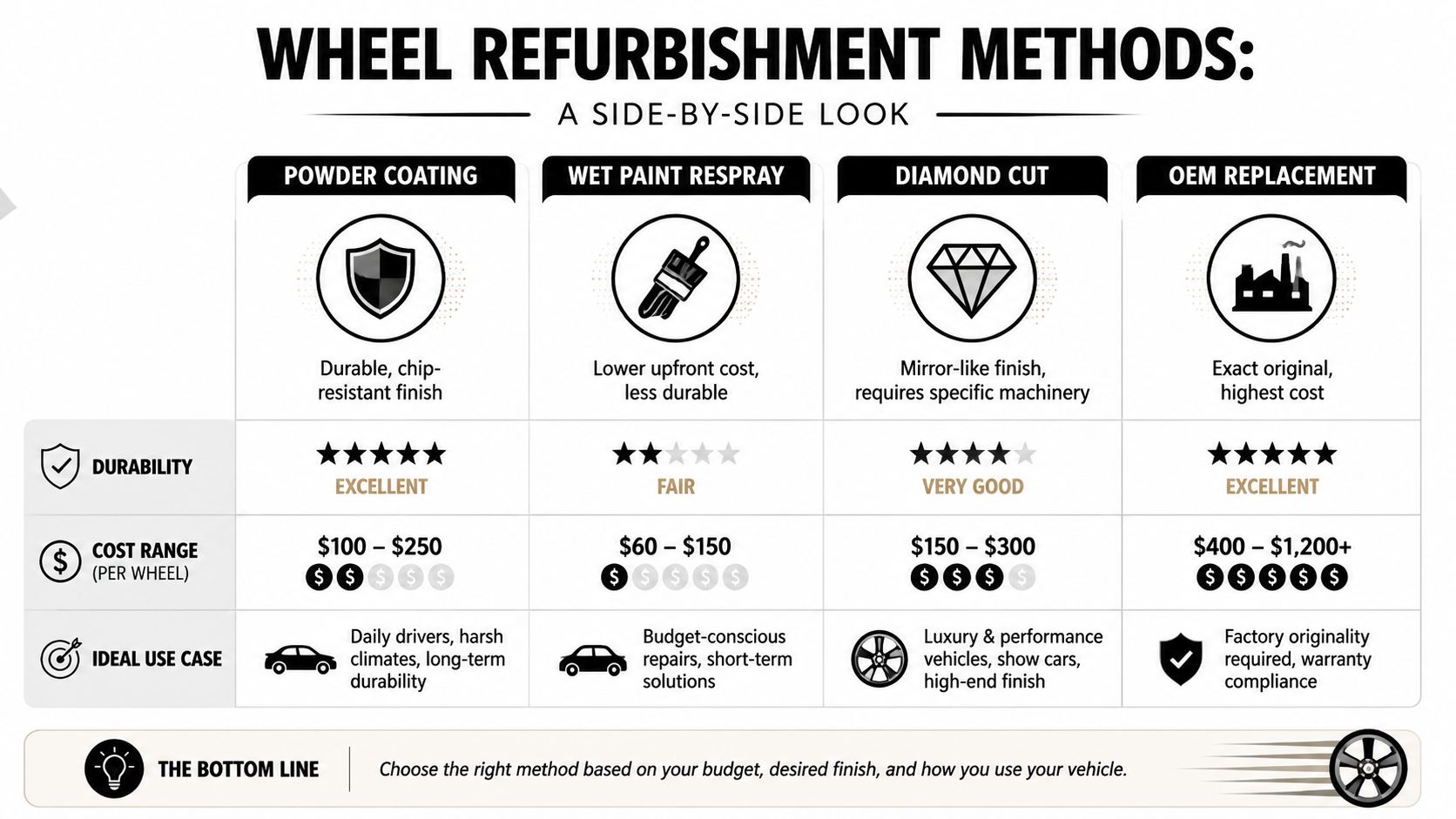
Powder coating is the sensible middle ground for many standard alloy wheels, but it isn't the right answer every time. If the wheel is diamond cut, heavily damaged, or a genuine OEM replacement is already cheaper, you need to choose differently.
Where powder coating makes sense
Use powder coating when the wheel is structurally fine, the finish is cosmetic, and you want a tougher result than a basic paint respray. It suits most standard full-face alloy wheels and gives a durable, uniform finish when the prep is done properly.
Wet paint is cheaper upfront, but it is the softer option. Diamond cut is a different process entirely, because it's there to preserve a machined face and specific OEM appearance. If the wheel started life as diamond cut, a normal powder coat changes the look and may not be the right repair.
When OEM replacement is the cleaner answer
A single genuine OEM replacement wheel makes sense when the wheel is beyond cosmetic refurbishment, when a diamond-cut face must be preserved, or when the refurbishment quote has crept too close to replacement cost. That is especially true for premium OEM alloys where the exact finish matters to the car's value and appearance.
For a useful comparison of why powder coating and painted finishes behave differently in service, see The Alloy Hub's powder coated or painted alloys guide. If you want the refurbishment route rather than replacement, that comparison should be the first filter.
When Refurbishment Stops Making Financial Sense
Refurbishment is not automatically the cheap option. On a badly corroded 21-inch diamond-cut wheel, the labour to strip, repair, coat, and clear can push the job into territory where a single genuine OEM replacement is the better buy. That's the point where the quote stops being cosmetic and starts being a value decision.
Compare the wheel, not just the finish
A standard powder coat quote covers the finish on a wheel that still has decent underlying condition. Once the wheel needs corrosion removal, major straightening work, or a finish that has to match a diamond-cut factory face, the cost rises quickly. The more specialist the wheel, the more likely it is that replacement protects both appearance and resale value.
This matters for premium cars. If the original wheel design is still available as a genuine OEM part, the price gap between refurbishing a damaged item and replacing it outright can narrow faster than people expect. That is why you should not accept a blanket “refurbish first” rule.
The right choice depends on the wheel's condition
If the wheel is sound and the issue is cosmetic, refurbishment is usually the smart move. If the wheel is heavily pitted, the face is machined, or the quote keeps climbing because the workshop is adding repair after repair, replacement is cleaner.
For a deeper look at this break-even point, see The Alloy Hub's alloy wheel repair and refurbishment cost guide. It is the better route when you need to decide between spending money on the wheel you've got and buying the one you should have.
How Long a Powder Coated Finish Actually Lasts
A properly done powder coat should last well on a road car, because the whole point of the process is durability against brake dust, salt, and stone chip wear. That said, lifespan is only as good as the prep and the day-to-day care.
What shortens the life
Poor surface prep is the big one. If corrosion, old lacquer failure, or contamination is left behind, the new finish can start failing early. A single-coat shortcut also reduces margin for error because you've lost the protection of a fuller coating system.
Kerb damage is another obvious killer. Once the wheel is physically damaged, even a strong coating can only do so much. Harsh acidic wheel cleaners can also attack the clear layer, so the wrong wash routine will shorten the finish life faster than most owners realise.
What keeps it looking right
Keep the wheels clean with sensible products and don't let brake dust sit on them for months. Road salt is part of UK life, so regular cleaning matters more than people think in winter. If the wheel was properly prepped and baked, the finish should stay presentable for years before you see normal cosmetic wear.
The standard to aim for is simple, a finish that looks good, resists road use, and does not need constant attention. That is what you are paying for when the quote is sensible and the workshop does the process properly.
Choosing a UK Refurbishment Shop Without Getting Burned
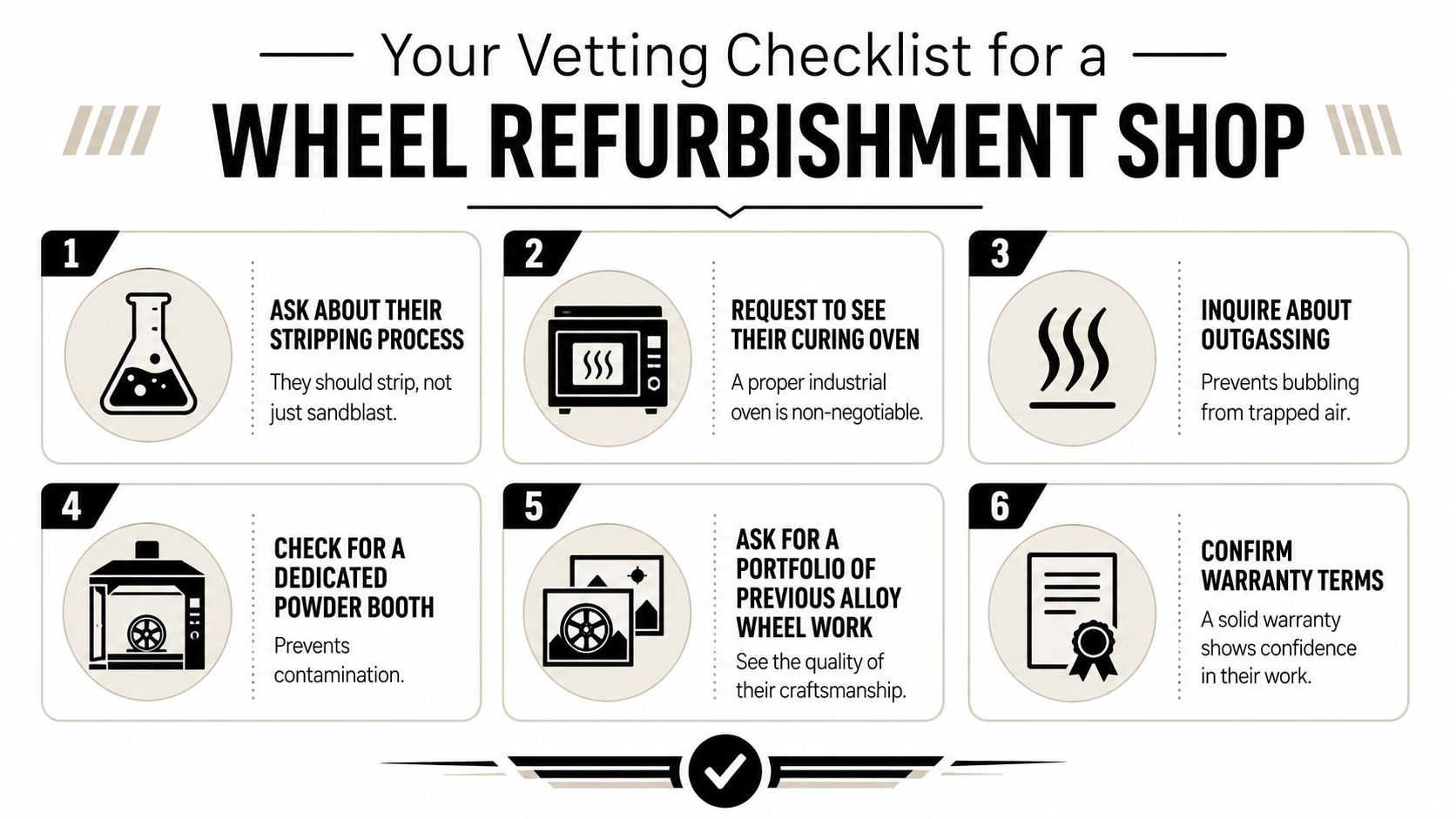
Ask direct questions before you hand over your wheels. If the answers are vague, walk away. A proper refurbishment shop should be able to tell you exactly how it strips, prepares, coats, and cures a wheel.
What to ask before you book
- Do you strip the wheel properly before coating? A real process starts with stripping, not a quick scuff and spray.
- Do you have an industrial curing oven? Proper cure control is essential.
- How do you deal with outgassing and corrosion? If they dodge that question, they're not set up for quality alloy work.
- Is the quote broken down by prep, finish, and any repair work? You need to know what you're paying for.
- What powder brand and finish do you use? Ask for the actual finish type, not just a colour name.
- What warranty do you give against peeling or early fade? A workshop that stands behind its process should answer this clearly.
If the quote is cheap and the process is fuzzy, you're buying a problem, not a finish.
The Alloy Hub Ltd refurbishes genuine OEM alloy wheels in Leek, Staffordshire, and handles powder coating in-house for customers who want the wheel done properly. If you want a straight answer on cost, condition, and whether refurbishment makes sense for your wheels, visit The Alloy Hub Ltd. or call 0330 133 8271.
FAQ
Is powder coating worth it for alloy wheels
Yes, if the wheel is structurally sound and you want a tougher finish than paint. It's especially sensible for standard OEM alloys that need a durable cosmetic refresh. If the wheel is diamond cut, badly corroded, or close to replacement cost, weigh it against a genuine OEM wheel before you commit.
Why is powder coating quoted per wheel
Because the cost sits in stripping, prep, masking, coating, and curing each wheel individually. Wheel size and condition also vary, so a set price for the whole car would hide the labour difference. Per-wheel pricing gives you a more honest quote.
Does a bigger wheel always cost more to coat
Usually yes, because larger wheels need more material, more masking, and more oven space. Complex spoke layouts also slow the job down. A simple 17-inch wheel is easier and cheaper to handle than a large premium wheel with a lot of detail.
Is a diamond cut wheel the same as a powder coated wheel
No. A diamond cut wheel has a machined face and a specific finish look, while powder coating covers the wheel with a baked-on coating. If you powder coat a diamond cut wheel, you change the original appearance. That's why matching the finish type matters before you book.
Should I repair one wheel or replace the whole set
If only one wheel is damaged and the others are in good condition, repair or a single OEM replacement usually makes more sense than replacing a whole set. If the wheel is heavily damaged or the finish no longer matches the car, replacement can be the cleaner choice. The right answer depends on condition and finish type.
What should a proper quote include
It should state whether stripping, corrosion removal, masking, and any repair work are included. It should also specify the finish type and whether the job is for one wheel or a full set. A quote that just gives a low number with no detail is not one I'd trust.
The Alloy Hub Ltd refurbishes genuine OEM alloy wheels, powder coats them in-house, and handles single wheels or full sets for UK customers who want the job done to a proper standard. If your wheel needs pricing or you want to know whether refurbishment still stacks up against replacement, call 0330 133 8271 and speak to the team directly.