
Most kerb rash and minor corrosion on BMW alloys can be refurbished. Buckles, structural cracks, and damage near the bead seat or spoke roots usually mean replacement with a genuine OEM wheel, not a rescue job.
A BMW owner usually finds this out the hard way after a pothole, a scrape against a kerb, or white corrosion creeping under the lacquer on a diamond cut face. The wheel still looks mostly usable, so the temptation is to ask for a tidy cosmetic fix and hope for the best. That's fine for surface damage. It's the wrong call for structural damage.
Table of Contents
- What Can and Cannot Be Repaired on a BMW Alloy Wheel
- Typical UK Costs for Repairing BMW Alloy Wheels
- How a BMW Wheel Is Refurbished Step by Step
- Structural Repairs, Buckles, and Cracks
- Matching OEM Finishes and Staggered Fitments
- When Genuine OEM Replacement Beats Any Repair
- Choosing the Right Path and Next Steps for Your BMW
What Can and Cannot Be Repaired on a BMW Alloy Wheel
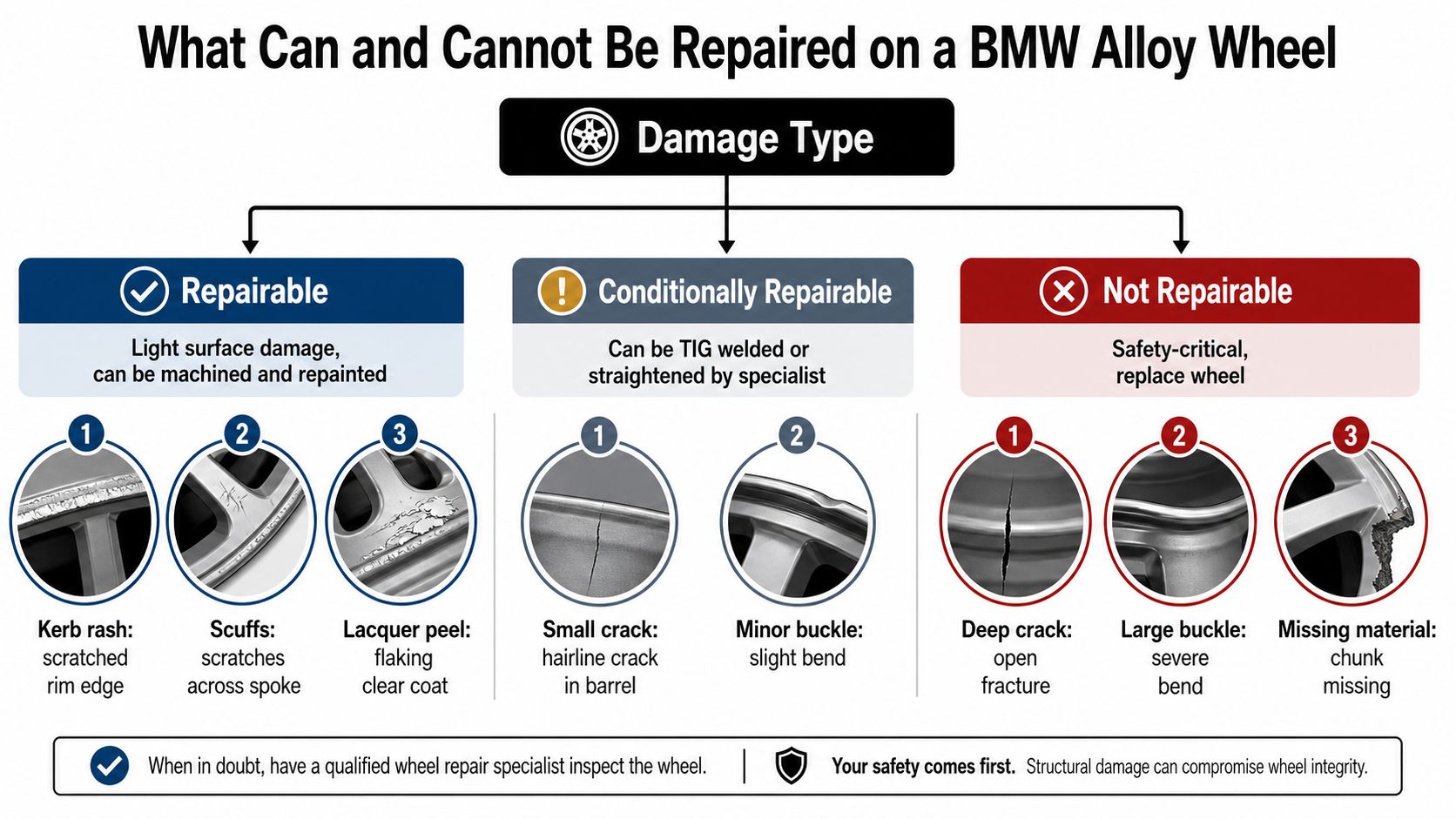
BMW alloy wheels fall into three camps, repairable, conditionally repairable, and replace now. Light kerb rash, spoke scuffs, lacquer peel, and surface corrosion are normal refurbishment work. A hairline crack or a slight buckle needs a proper assessment. A deep crack, missing metal, or damage in a structural zone needs a genuine OEM replacement.
Read the wheel, not just the scratch
The outer lip tells you a lot. If the damage is just abrasion, a specialist can sand, fill, refinish, and match the wheel back into the set. If the wheel is losing air, wobbling, or visibly bent, you're in structural territory and the conversation changes fast.
Only cast alloy wheels can be repaired, and that's an important boundary. Fine machined wheels are not in the same category, and cracks near the bead seat, spoke roots, or inner barrel are structural concerns that should push you to replacement rather than welding, because those zones carry load and heat differently Aluminium Wheel Repair guide. That's the blunt answer, not the optimistic one.
Practical rule: if the wheel is only ugly, refurbish it. If it's distorted, cracked in a load bearing area, or missing material, replace it.
For owners comparing a damaged BMW against a rougher example such as bidding on BMW Z at Copart, that distinction matters because the wheel can be the difference between a straightforward refurb and a proper parts hunt. Cosmetic damage is a finish problem. Structural damage is a fitment and safety problem.
Typical UK Costs for Repairing BMW Alloy Wheels
BMW alloy wheel repair in the UK is not cheap, but it's still usually cheaper than replacing a genuine wheel. The job is to judge whether the quote reflects cosmetic refurbishment, diamond cut work, or structural correction. If someone gives you one price for all three, they're either oversimplifying or not telling you enough.
Typical UK BMW Alloy Wheel Repair Costs
| Repair Type | Typical UK Price | Where It Is Done |
|---|---|---|
| Minor kerb rash | £50 to £80 per wheel | Mobile repair service |
| Heavy kerb damage, corrosion, minor buckle | £80 to £150 per wheel | Workshop |
| General alloy refurbishment at BMW level | £80 to £130 on average | UK refurbishment market |
| BMW average in national quote data | £294.03 | National quote dataset |
| BMW one wheel repairs | £139.73 | National quote dataset |
| BMW four wheel refurbishments | £477.32 | National quote dataset |
| Dick Lovett BMW alloy wheel refurbishment | from £110 per wheel including VAT | BMW retailer workshop |
| Dick Lovett BMW diamond cut refurbishment | from £160 per wheel including VAT | BMW retailer workshop |
| BMW UK damage charge matrix, alloy wheel gouge refurbish | £33.00 per wheel | Return process matrix |
BMW sits above the general market average. RAC says alloy wheel refurbishment usually costs £80 to £130 on average, but its brand guide also shows BMW at £294 and Audi at £253 RAC cost guide. That's the premium end of the market talking, not a cheap mobile touch up.
BMW UK's own damage charge matrix lists an alloy wheel gouge refurbish charge of £33.00 per wheel BMW damage charge matrix. That's useful context for lease returns and part exchange checks, because it shows how the manufacturer itself categorises minor damage. It doesn't mean every damaged wheel should be fixed at that price, it means return inspections are measured and specific.
Straight answer: if your BMW wheel is only scuffed, you're usually in refurb territory. If it's cracked or buckled, the price of safety work moves the job into replacement logic.
How a BMW Wheel Is Refurbished Step by Step
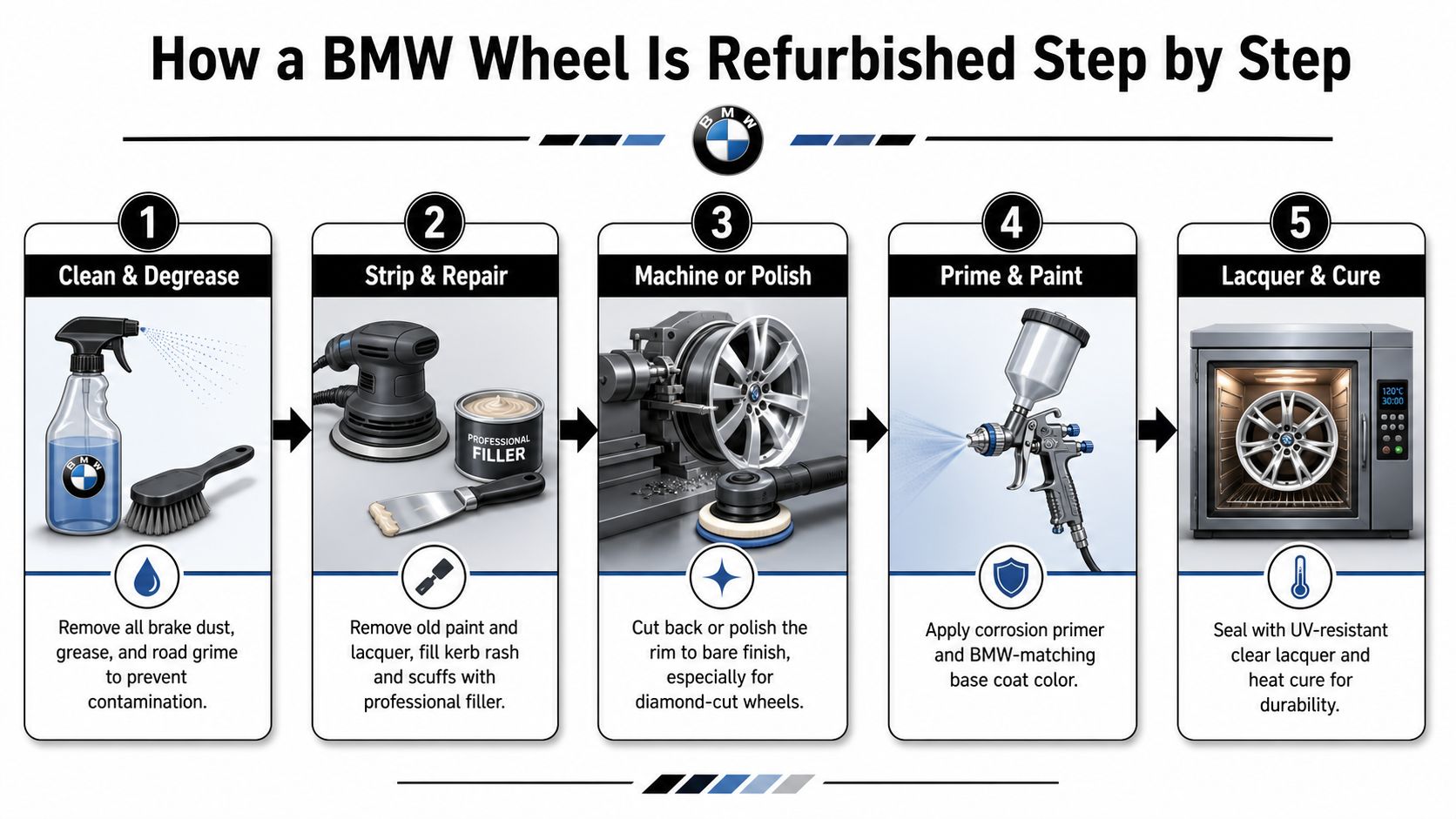
The proper refurbishment process starts long before paint goes on. A wheel that hasn't been cleaned and degreased properly will fail sooner, because brake dust, road film, and old residue stop coatings bonding. That's why the first sensible workshop step is always a full strip and clean.
The sanding sequence matters
Heavy kerb damage is normally taken down with roughly 80 to 120 grit, then smoothed with 240 to 320 grit before refinishing wheel finish specialist guide. That sequence matters because it creates a consistent substrate for filler and primer. Jump straight to a fine grit and you'll leave low spots behind, which can show through the final coating.
The wheel then gets repaired where needed, primed, and finished. On a solid colour wheel, powder coating is often the practical route. On a wheel that needs a precise colour match, paint work is used to blend the finish properly.
Diamond cut work is a different job
Diamond cut faces are not just painted silver with a shiny edge. If the lacquer has failed, the face normally has to be re cut on a lathe before fresh lacquer goes on. That extra machine work is why diamond cut refurbishment costs more and why badly damaged diamond cut wheels are often poor candidates for repeated repair.
The same specialist discipline shows up in other industries too. A good reference point is surface finishing for end use aerospace parts, where clean preparation and controlled coating are non negotiable. Wheels are not aircraft parts, but the principle is the same, if the substrate is wrong, the finish won't last.
For readers who want a closer look at the workshop side, the process is outlined on The Alloy Hub refurbishment overview. That's the part most owners never see, and it's where a good refurb is won or lost.
Structural Repairs, Buckles, and Cracks
Cosmetic damage and structural damage require different approaches. Once a BMW wheel is bent, cracked, or leaking air, you are no longer discussing appearance. You are deciding whether the wheel is still fit to stay on the car.
Welding has a narrow lane
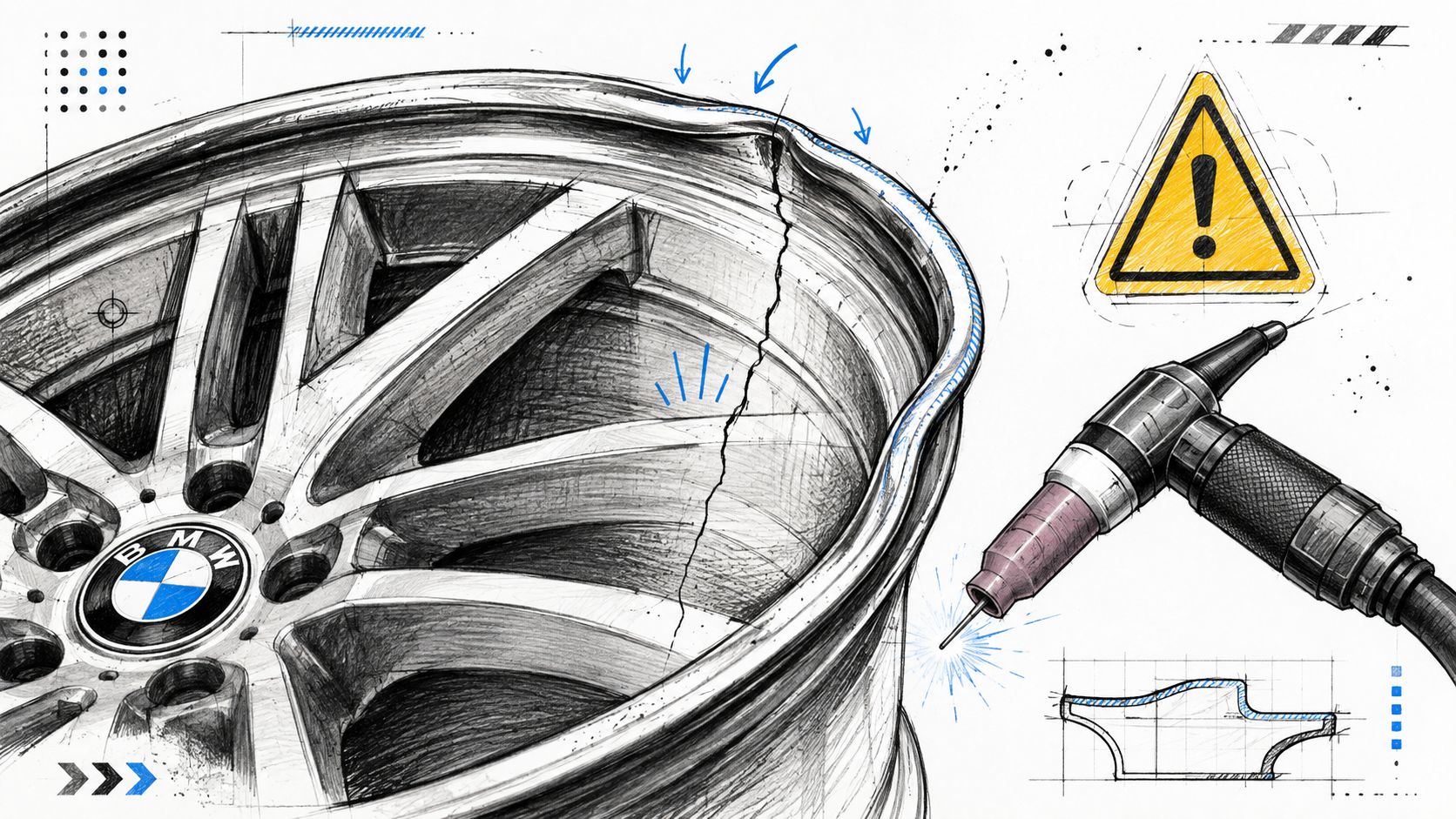
Small cracks can sometimes be TIG welded by a specialist, but that does not make every crack a repair candidate. Independent BMW repair guidance says deeper cracks or cracks in critical structural areas should be replaced, not welded BMW cracked alloy wheel guidance. That is the sensible line. Anything else is wishful thinking.
Buckles are a separate job. A specialist machine can straighten a wheel back towards roundness, with a practical benchmark of restoring it to within about 0.005 inches of true form. That level of accuracy matters on an OEM BMW wheel, because a wheel that is still out of true will keep feeding vibration through the car even if it looks better on the bench.
Checks after the repair matter
Once a wheel has been welded or straightened, it must be rebalanced and checked for alignment. If that is skipped, the car can still vibrate, pull, or wear tyres unevenly even though the wheel has been cosmetically improved. The repair is only as good as the final runout and balance check.
A repaired structural wheel should be treated as monitored, not forgotten. Every tyre change is the right time to inspect it again for fatigue or a reopened crack.
For a more detailed breakdown of repair limits, see whether a cracked alloy wheel can be repaired. If the crack sits near the bead seat, spoke roots, or inner barrel, replace the wheel. That is the correct decision, not the expensive one.
Matching OEM Finishes and Staggered Fitments
Most BMW wheel repair complaints are really finish complaints. The repaired wheel is technically fine, but it stands out because the colour, cut, or sheen doesn't match the other three. That's why BMW owners need a finish decision, not just a repair decision.
The finish has to suit the car
BMW factory finishes commonly include standard silver, gloss black, Ferric Grey, bi colour, Orbit Grey, and diamond cut faces. If the wheel on the car is one of those more complex finishes, the repair has to match it properly or the eye catches it instantly. A rough silver paint job on a factory diamond cut wheel is a downgrade, not a repair.
Staggered fitments add another layer. Front and rear wheels can differ in width and offset, so a single replacement wheel has to match the correct axle. The wheel might look identical from five feet away and still be wrong for the car. That's why the OE part number matters more than what the spokes look like.
Fitment details are not decoration
TPMS transfer, centre bore, offset, and width all matter when a single BMW wheel is being sourced to match a set. If those details are off, the wheel can fit badly even if it looks right on the bench. That's the trap with older sets, where the colour fade and road grime can hide the fact that the replacement isn't an exact match.
Practical rule: on a 3 Series M Sport, match the wheel to the axle and the finish to the factory spec. If either one is wrong, the car will show it.
The right reference point for a darker OEM look is BMW anthracite alloy wheel guidance. If you're dealing with a three year old set, the finish match is usually harder than the fitment match, and that's where genuine OEM supply beats guesswork.
When Genuine OEM Replacement Beats Any Repair
There are times when refurbishment is the wrong answer. If the wheel is structurally damaged, if the finish can't be matched cleanly, or if the owner wants the exact wheel the car left the factory with, replacement is the better long term call. That's especially true on premium BMWs where the wheel is part of the car's identity, not just a round object with tyre on it.
Why genuine OEM matters
OEM wheels are built and tested to the vehicle's load rating and structural tolerances. Replica wheels are not the same product, and the saving usually disappears once you factor in insurance concerns, resale value, and the risk of buying a wheel that looks similar but doesn't match the car properly. If a wheel is for a BMW, the safe answer is a genuine BMW wheel with the correct part number.
That matters even more on a single wheel replacement. You need the same offset, centre bore, and finish or the car won't look or behave like a matched set. If the job is close to the cost of a new genuine wheel, refurbishing the damaged one stops making sense.
A useful commercial comparison comes from guide to auto appraisal for total loss, because it shows how quickly repair versus replace decisions turn into value decisions once damage is assessed properly. Wheels are no different. If the repair is approaching half the price of a genuine replacement, replacement usually wins.
The Alloy Hub deals in genuine OEM wheels only, and it also buys wheels back against an upgraded set. That's the right model for BMW owners who need a match, not a compromise.
Choosing the Right Path and Next Steps for Your BMW
Start with the damage type. If it's kerb rash, corrosion, or lacquer failure, refurbishment is usually the right move. If it's a buckle, a crack, or air loss from a structural area, replacement should move straight to the top of the list.
Check the finish next. If your BMW has a diamond cut face, a bi colour wheel, or a staggered setup, matching matters as much as repairing. Then compare the cost of refurbishing against a genuine OEM replacement, because a cheap repair that leaves the wheel looking wrong is money wasted.
UK roads keep producing pothole damage, so you're not being unlucky. You're just dealing with normal BMW wheel abuse on British roads, and the correct answer is to be honest about what can be saved.
The Alloy Hub Ltd supplies genuine OEM BMW wheels and carries out wheel refurbishment in Leek, Staffordshire, including straightening, powder coating, and diamond cut work where the wheel is salvageable. If you want the wheel inspected properly or matched to a genuine replacement, visit The Alloy Hub Ltd. and get the right answer before you spend money twice.


